



What is visual programming?
Visual programming offers a code-free way to create software applications using graphics to represent components and their interactions. This intuitive approach enables developers to build complex programs effortlessly and quickly, often using flowcharts, diagrams, or other visual representations to depict the structure and behavior of the software.
Widely applicable in web and mobile app development, visual programming offers numerous benefits, including:
- Usability and accessibility: Visual programming environments typically have intuitive and user-friendly interfaces. By eliminating the need to write complex code, programming becomes more accessible to people who have little to no coding experience.
- Rapid development and prototyping: Because visual programming enables rapid prototype and iteration, users can quickly assemble and test components. It helps developers understand the impact of their development changes by providing real-time feedback and visualizing program execution.
- Improved debugging: Visual programming language debuggers highlight errors directly in the visual representation, making it easier to identify and resolve issues.
Visual programming vs. traditional programming
Visual development and traditional development are two different approaches to creating software.
Traditional development typically involves writing code in a text-based programming language, like as C++, Java, or Python. This code-based app development approach requires the developer to have a strong understanding of the language and its syntax, as well as the concepts of programming, such as data structures and algorithms.
Visual development, on the other hand, uses visual elements, such as diagrams and flowcharts, to represent programming constructs. Visual development environments typically have drag-and-drop interfaces.
Depending on the visual development tool and who it targets, it allows professional developers to accelerate their productivity, or users with no programming background to create software.
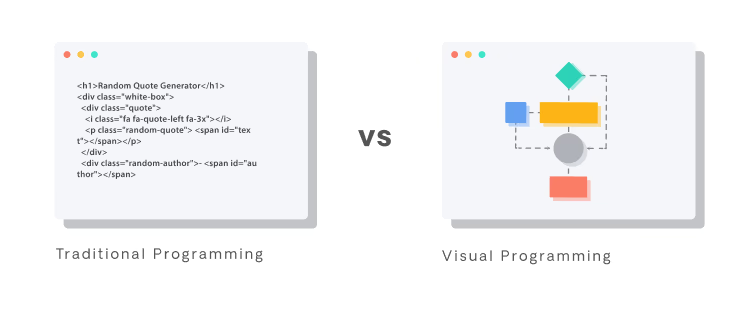
Overall, the main difference is that traditional development focuses on the actual coding and writing of the code, while visual development focuses on the design and overall structure of the software.
Examples of visual programming languages
Some visual programming examples include:
- Scratch: Primarily used in education, This language enables users, particularly children, to build interactive stories, games, and animations by snapping code blocks together.
- Blockly: This drag-and-drop programming tool can be used as a standalone application or integrated into web applications to create custom visual programming environments.
- LabVIEW: This National Instruments system design platform and development environment is commonly used in engineering, data acquisition, and industrial automation applications.
- Unreal Engine’s Blueprints: This visual scripting system known as Blueprints from Epic Games enables game developers to create gameplay elements and logic without using traditional coding.
- App Inventor: This visual programming environment allows users to create mobile apps for Android devices using a drag-and-drop interface.
What’s the role of visual programming in the software industry?
For a long time, visual programming has had the reputation of being a teaching tool for beginners to get familiar with programming concepts, and to create simple user interfaces and prototypes. The reason for that has to do with its background.
Visual programming’s hype peaked in the early 90s with CASE tools. And, as with all trends ahead of their time, the repercussions of its failure were years of underinvestment, little innovation, and lingering skepticism.
UML (Unified Modeling Language), with its promise of bringing sanity to object-oriented programming, hasn’t helped either, although much of its faults were due to the underlying complexities related with inheritance.
And even more recent trends, like Business Process Modeling, probably did more harm than good in giving credibility to this area.
As software development becomes increasingly more complex, with new frameworks, technologies, devices and touchpoints to be considered, developers are ordinary people with extraordinary specializations.
That complexity and specialization are badly suited to the pure visual programming of those early tools, but it also makes it increasingly hard to build rounded software engineering teams. Yes, visual programming environments might have failed as they:
- Aren’t extensible
- Generate slow-code
- Provide a painful developer experience
- Are limited to simple use cases
But where they failed, a whole cache of similar tools took the best of visual programming and combined it with text-based coding. Whereas visual programming was “no-code,” these new tools are low-code.
Low-code and visual programming
Low-code technology lets developers create software visually by drawing interaction flows, UIs, and the relationships between objects, but supplementing it with hand-written code where that’s the better thing to do.
This pragmatic mix of visual and text-based programming is well-suited to the needs of modern software development.
Low-code platforms reduce the complexity of software development and return us to a world where a single developer can create rich and complex systems without learning all the underlying technologies.
Next generation of visual programming: delivering on the promise
Visual programming held so much promise, and the problems that it wanted to solve haven’t gone away.
In fact, they’re more relevant than ever.
But real-world problems demand greater flexibility than visual programming could offer. Low-code takes that promise and applies it to reduce the complexity we find in modern software development.
So, ask not "what is visual programming?" Instead, ask "what is low-code?".
Useful resources


Visual programming frequently asked questions
In visual coding, programmers create software applications using visual elements such as diagrams, flowcharts, and symbols instead of traditional lines of code.
In the same way as visual programming, a programmer selects and arranges prebuilt blocks of code or logic elements to create a program.
The Visual Basic is a programming language. Microsoft developed this object-oriented programming language in the 1990s. With Visual Basic, developers can create graphical user interfaces (GUIs) and applications for Windows.
Visual programming is a programming approach that represents the programming process graphically instead of using text. This method enables users to create programs by manipulating graphical elements instead of writing code. It is designed to make the development process more intuitive and accessible, particularly for individuals with limited coding experience.
"Scratch," MIT's iconic visual programming platform. Designed with children in mind, Scratch empowers users to easily create interactive stories, games, and animations through a user-friendly drag-and-drop interface. By assembling blocks that represent various functions and commands, users can effortlessly construct complex programs without the need for traditional coding.
An example of visual coding is "Blockly" by Google. Blockly uses interlocking, graphical blocks to represent code concepts like variables, logical expressions, loops, and more. It's often used in educational settings to teach programming concepts visually and is integrated into various online platforms and apps for educational purposes.
C++ is not a visual programming language. It is a high-level, general-purpose programming language that requires text base coding. However, there are development environments for C++ that incorporate visual tools (like Microsoft's Visual Studio) to aid in the development process, but the core language itself is text-based and not inherently visual.