
2. Data integration
Data integration in app development is effortless with OutSystems. Our Data Fabric capability and its unique data virtualization layer seamlessly unify data from various sources. This ensures smooth data integration and consistent treatment regardless of the origin, allowing companies to unleash the true potential of their enterprise data. App-to-data connections are further expedited by a range of out-of-the-box connectors that simplify liaising apps and data. Such consolidation of data sources into a central repository guarantees permanent availability for improved data discovery and enabling data-driven app improvements.
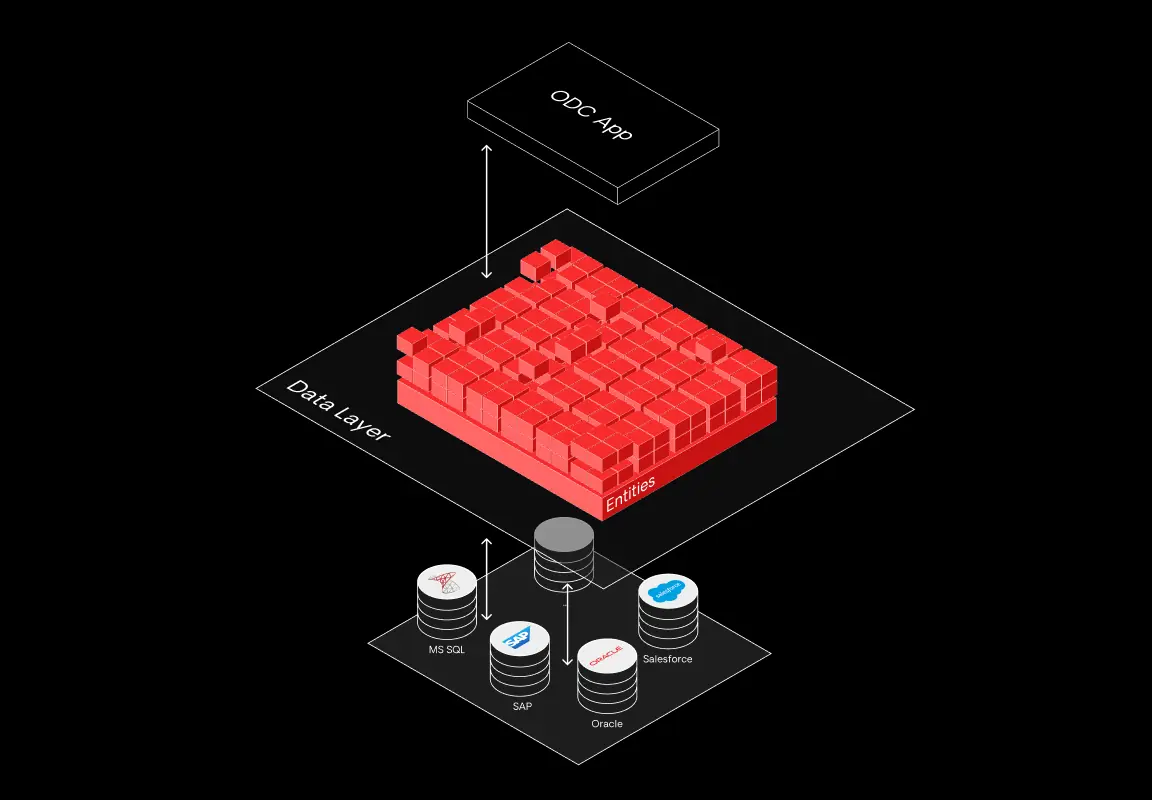
Table of contents
- A single source of data
- Data validation and modeling
- Support for different data formats
- Data Caching
The OutSystems low-code platform is engineered to streamline the entire data integration process. Connecting to external systems, whether they use REST APIs, SDKs, REST, SOAP, or other methods, is no longer a concern. The platform abstracts these technical details. Additionally, it eliminates the need for complex solutions to access private resources within your network, removing the burdens of setting up VPNs or SSH tunneling through the usage of our Private Gateway capability.
Learn more about OutSystems Private Gateway
On the data front, the platform offers significant simplification. It handles tasks like data retrieval, type conversion, and data mashup from various sources programmatically. This means you can fetch data, manage performance, optimize payload size, implement pagination strategies to prevent application overload, and harmonize data structures, all without the need for extensive custom development. These capabilities, which would typically take months to build, are available out of the box.
A single source of data
Our robust virtualization layer plays a pivotal role in data unification, bringing together data from various sources into a single, standardized interface. Users can seamlessly query, combine, and manipulate data as if it were any other entity in the platform, regardless of its original source. Not only does this simplify data usage, but it also allows for seamless data mashups between different sources.
When data sources are centralized, creating reusable custom datasets is much simpler and blending data from diverse origins is seamless. Paired with a data governance model, centralization enables you to use data and customize it for the different lines of business. These datasets become readily available for use across the entire app portfolio, fostering data-driven innovation and efficiency throughout the organization.
Data validation and modeling
OutSystems users benefit from our TrueChange and Impact Analysis capabilities, which support in-depth data validation and modeling at development time and while staging applications. The platform assesses the ramifications of changes, whether they occur in local or external data sources, across all applications and stages. Developers find value in our entity diagram section, a visual tool that facilitates data source creation and modeling, depicting the several entities and their relationship with each other.
Learn more about OutSystems Data Modeling mechanisms
Support for different data formats
OutSystems Data Fabric simplifies data access and integration for your applications. The OutSystems low-code platform empowers you to effortlessly query and combine data from diverse sources, whether relational or not. This enables powerful aggregate functions and unlocks a host of new features you can easily integrate into your applications. The added benefit is that any custom datasets you create are reusable without limitations. This not only eliminates the need for redundant integration work but also establishes a data catalog for effortless discovery and reusability across your app development requirements.
Data Caching
To enhance application performance, OutSystems incorporates built-in data caching mechanisms. This cache boosts performance by temporarily storing previously retrieved or calculated data in fast memory, ensuring efficient loading for future requests.