



What is digital transformation?
Digital transformation integrates technology into all areas of a business to reimagine processes, models, and customer experiences. The goal is to adopt new tools to foster a culture of innovation that aligns people, processes, and technology.
This alignment empowers organizations to deliver value more effectively, driving impact in three key areas:
- Customer experiences: Seamless, personalized interactions at every touchpoint.
- Operational processes: Streamlined workflows with automation and intelligent systems.
- Business models: Unlock new revenue streams by rethinking value delivery with modern technology.
Why is a digital transformation strategy necessary?
Without digital transformation, businesses risk falling behind competitors, facing inefficiencies, and having unhappy customers.
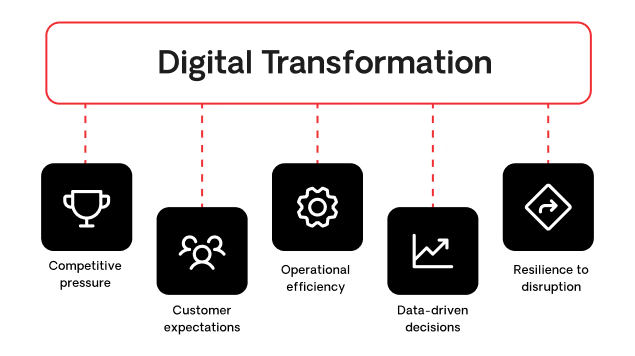
Here’s why a digital transformation strategy matters:
- Competitive pressure: It can help you stay ahead by innovating faster than competitors clinging to outdated processes.
- Customer expectations: Digital transformation makes it easier to meet expectations for hyper-personalized and seamless interactions.
- Operational efficiency: Digitizing operations can help you save costs and increase productivity.
- Data-driven decisions: With digital transformation, you can better use analytics for informed, strategic decision-making.
- Resilience to disruption: You are less affected by challenges from market changes like remote work or supply chain issues.
"Companies that prioritize digital transformation do more than survive. They thrive. OutSystems accelerates this journey, delivering value at scale."
Paulo Rosado Founder and CEO of OutSystems

How is AI fueling digital transformation technologies?
AI is a key part of digital transformation. It drives insights, automation, and innovation. This reshapes important areas in many industries. It helps organizations reach their full potential in areas like:
- Customer service: AI chatbots deliver personalized, 24/7 support.
- Supply chain management: Predictive models optimize inventory and anticipate demand.
- Data analytics: ML uncovers actionable trends and patterns.
- Marketing: Hyper-personalized campaigns increase customer engagement.
With tools like OutSystems, organizations can integrate AI and ML to deliver smarter, faster solutions.
Challenges of digital transformation
Despite its benefits, there are disadvantages of digital transformation that require strategic solutions:
- Legacy systems: Outdated tech slows progress and hinders scalability.
- Resistance to change: Teams accustomed to traditional methods may struggle to adapt.
- Talent shortages: Finding skilled professionals to manage modern technologies is a barrier.
- Organizational silos: Miscommunication between departments can disrupt projects.
- Cost of implementation: Upfront investment can be daunting without clear ROI.
Traditional coding methods can often increase these very challenges, creating additional setbacks that lead to:
- Lengthy development cycles, delaying innovation.
- Limited scalability and adaptability to market changes.
- High dependency on specialized developers, increasing talent shortages.
The role of low-code in digital transformation
Low-code platforms like OutSystems make digital transformation easier. They provide technology that helps businesses innovate faster and use fewer resources, offering several benefits:
- Deploy applications up to 10x faster.
- Enable teams of different expertise to develop fully functional apps and collaborate effectively.
- Accelerate adaptation to new business needs.
- Integrate legacy systems and modern technologies.
- Reduce the cost of app development.
How OutSystems addresses digital transformation challenges
For IT leaders:
- Holistic change: OutSystems drives enterprise-wide agility by simplifying the integration of legacy systems and fostering a digital-first culture.
- Future-proof technology: OutSystems provides cutting-edge features like generative AI tools; when underlying technology changes, it evolves with it.
For IT pros:
- Backlog reduction: Accelerate development timelines and meet business demands faster.
- Collaboration: Facilitate seamless communication between IT and business teams.
- Integration: Ensure compatibility with existing tech stacks.
- Governance and compliance: Ensure alignment with organizational standards using security features and application lifecycle management.
- Modernization: Leverage flexible approaches for updating or replacing legacy systems.
For Developers:
- Ease of use: Pre-built modules and templates simplify development and reduce time-to-market.
- Customization: Empower developers to tailor solutions to meet specific business needs.
- Support: Access robust tools for real-time testing, feedback, and performance monitoring.
For Line of Business Leaders (LOBs):
- Business outcomes: Achieve revenue growth, cost savings, and operational efficiency with tailored applications.
- Ease of adoption: Reduce training overhead with intuitive tools.
See how leading organizations are driving innovation with digital transformation strategies
HEINEKEN’s success: A digital transformation case study
HEINEKEN adopted OutSystems low-code as part of its Evergreen strategy centered on customer centricity, productivity, and urgent business digitalization. As a result, the company has:
- Given 1 million hours back to the business
- Customized digital experiences
- Increased automation and efficiency
“The EverGreen strategy translates into becoming the best-connected brewer. This strategy comprises several elements, one of them being the use of hyperautomation to support our productivity and digitalization ambitions."
Mark Sleijpen Global Digital Technology Toolkit Manager, at HEINEKEN

Accelerate your digital transformation
Digital transformation is an ongoing journey requiring innovation, agility, and collaboration. OutSystems empowers organizations to overcome challenges and seize opportunities.
Are you ready to modernize your business? Schedule a demo with OutSystems today to experience the power of low-code and AI tools in accelerating your digital transformation.


Digital transformation common questions
Yes, low-code platforms like OutSystems excel at modernizing legacy systems. They can provide modernized user interfaces, extend existing functionality, or completely refactor or rebuild outdated systems, all while maintaining integration with critical legacy infrastructure.
Most internal workflows can be digitized and automated within weeks. Low-code platforms use pre-built components and visual tools to streamline the design, development, and deployment processes, ensuring rapid results.
Low-code platforms are used for building:
- Customer portals for account management
- E-commerce platforms
- Mobile apps for personalized customer experiences
- Chatbots and real-time service platforms
Common examples include:
- HR processes like onboarding and performance management
- Procurement and inventory management
- IT support and help desk automation
- Expense tracking and approval systems
Yes. Low-code platforms can integrate with existing applications through APIs or pre-built connectors, enabling you to add new features, improve interfaces, or extend functionality without disrupting core systems.