
2025 IDC MarketScape: Low-Code and No-Code Technologies

Software executives around the U.S. are rapidly embracing next-generation AI across software development life cycles (SDLC). The growing commitment to AI is exemplified in investment trends, with 96% of North American companies surveyed by OutSystems and KPMG planning to boost their AI investments in the coming year. This near-universal intent signals a growing consensus on the strategic value of AI-driven innovation, with 58% of organizations intending to increase their investments by 11% to 20%. This reflects a slightly more aggressive stance compared with Europe, where 46% of organizations anticipate similar growth.

Agentic AI adoption accelerates, with the U.S. edging out Canada
One of the key themes of this year’s survey is the rise of agentic solutions, the latest major innovation in the world of AI. Agentic AI refers to intelligent systems that can autonomously perceive, plan, act, and adapt without relying on step-by-step human direction. These agents break down complex goals into tasks, interact with APIs and tools, evaluate results, and iterate independently. In this video, OutSystems VP of Product, AI & AppDev explains what is needed to make this work.
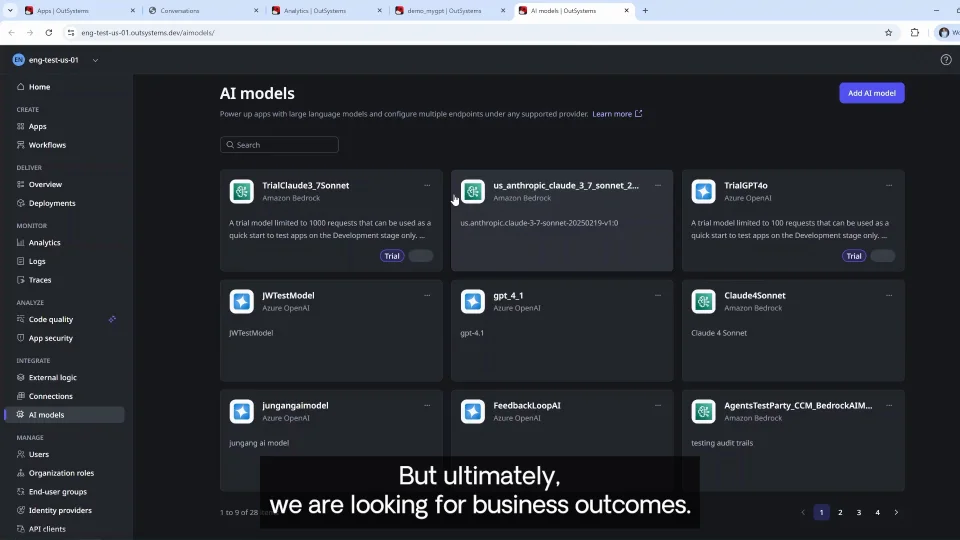
In this blog, we’ll take a look at what the OutSystems and KPMG survey results can tell us about Agentic AI in North America.
Integrating agentic AI into the SDLC
Almost half of North American companies surveyed said they have already integrated agentic AI at various stages of the software development lifecycle (SDLC). The U.S. leads the way in this adoption at 52% compared with 44% in Canada. Both countries are ahead of Europe, which comes in at 40%. Interestingly, Canadian organizations are more likely to be in the experimental stage, running pilots rather than actively integrating agentic solutions into production environments. However, in the U.S., they're increasingly being embedded directly into applications to autonomously perform complex, multi-step tasks.
The top use cases
In the U.S., leading use cases for agentic AI include automation of internal business processes, using AI agents to enhance customer experiences, and code generation and completion. For these high-value, complex integrations, a unified platform approach is critical, providing the foundational governance and interoperability needed to safely scale autonomous agents across mission-critical systems.
By contrast, Canadian organizations were primarily focused on relatively low-impact use cases such as document generation and code reviews for quality assurance, indicating a more risk-adverse and tightly controlled approach.
Sourcing agentic AI tools
Further notable differences arose in how organizations in the U.S. and Canada sourced agentic AI tools. In the U.S., 37% of those surveyed were actively developing their own custom AI agents using proprietary tech stacks and traditional code, far outpacing Canada, where in-house development teams tended to favor open-source development tools.
Moreover, Canadian businesses appeared more inclined to look externally for their AI tooling, with 14% of those surveyed preferring to buy prebuilt AI agents from vendors, compared with just 2% in the U.S. This greater reliance on off-the-shelf agentic tools could point to potential resource constraints and a smaller pool of specialized talent. That said, fewer than half of Canadian executives surveyed said they believed that AI would create new, specialized roles, compared with 77% in the U.S.
Governing and managing agentic AI
Overall, the survey found a significant difference in how U.S. and Canadian companies perceive agentic AI and the rates of adoption. Evidently, a great deal of this comes down to confidence in the ability to govern and manage these tools.
Over half of U.S. software executives surveyed rated their ability to govern and monitor the use of traditional and agentic AI tools as excellent. That’s far ahead of Canada’s 32% and Europe’s 29%, suggesting that U.S. companies, on the whole, felt better equipped to control their AI deployments, an increasingly essential factor as AI becomes deeply embedded in business operations.
The OutSystems and KPMG report, Navigating Agentic and Generative AI in Software Development: Human-Agent Collaboration is Here, digs deeper into how organizations around the globe are adopting and using agentic AI.


