
Data Fabric Solutions for Data Management

If your organization has ever delivered an app, you know that orchestrating the data behind it is often the hardest part. Let’s say, for example, that you have a list of sales order items in SAP with a product ID. Based on this ID, you need to pull in information from another data source about where that item was purchased. To accomplish this, you have two main options:
- Make lots of API calls. You can make numerous calls to this new and different source to get the missing information per sales order item, every time you need it. This means you’re always getting accurate data, but it also means you’re putting a big load on the system, so performance often suffers.
- Cache data. You can cache all the information locally, which saves you on API calls, and thus performance. But it also means that the data you’re pulling is only as recent as when it was cached.
Because the first option often results in poor performance, you choose the second. You make a join based on the ID and put the information together. But, to make up for pulling cached data, you also have to set up data synchronization mechanisms and make sure they are working correctly.
It sounds complicated because it is–the whole process normally takes days of development time. We built OutSystems Data Fabric (Data Fabric) to reduce or eliminate that time.
Now, your applications can access the data they need quickly and without performance issues, and you can set it up in just a few clicks. In this blog, you’ll meet OutSystems Data Fabric, learn its benefits, and see how you can use it.

Understanding Data Fabric
A data fabric is a data layer that sits above the various sources and systems to unify data from disparate sources, abstracting the complexity of underlying data systems. It creates a single, consistent view of data across different silos, making it easier to access, manage, and analyze. It also ensures that data is always where it needs to be, when it needs to be there for effective data management. As a result, organizations can quickly adapt to changing data requirements and easily integrate new sources and technologies.
For more detail about data fabrics in general, check out our blog titled Data fabric decoded.
Meet OutSystems Data Fabric
OutSystems Data Fabric is an advanced virtual data layer that brings simplicity to the process of adding data-based functionalities to applications. It integrates data from hundreds of sources, such as Salesforce and SAP, eliminating complexity and reducing data silos, and supporting custom data set creation.
It can incorporate data from external databases, legacy systems of record, and SaaS applications, centralizing and simplifying data management. This accelerates app performance and eliminates the complexity of manually mapping data. Plus, with robust security and governance controls, your data always remains safe no matter where it resides. It can make your data more useful, your apps more intelligent, and your whole IT landscape more flexible.
Why you need Data Fabric: The benefits
With Data Fabric, there is no more complexity, no more scattered data, and no more arduous development to pull it all together. With a single data layer, you can easily mix-and-match data sources to build mission-critical applications that require the consolidation of all kinds of data sets. Here are some of the other key benefits of OutSystems Data Fabric.
Simplification
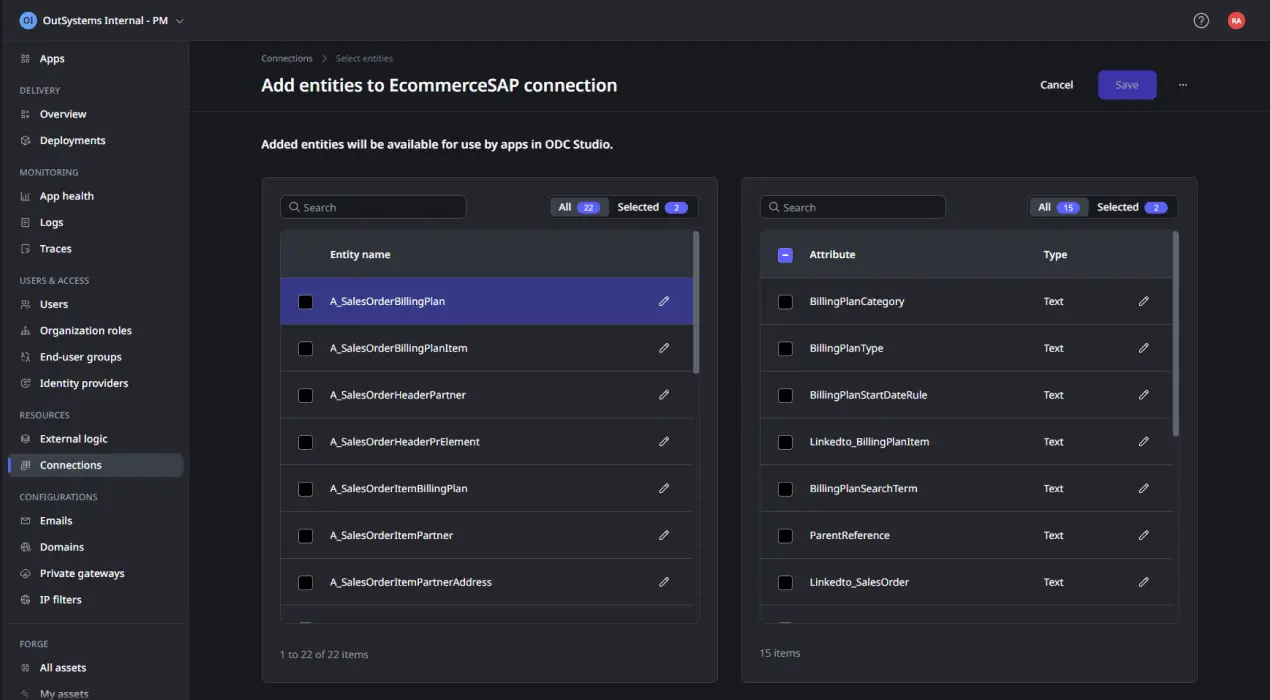
OutSystems Data Fabric dramatically simplifies the process of discovering, combining, and reliably retrieving data by consolidating multiple sources into a custom data set. Easily query and mashup data from different sources, in a single data experience, regardless of whether it is relational data or not. Data Fabric also frees you from the struggle of making your enterprise data available for apps.
Instead, you gather all your data in one place, so you can easily mix-and-match it and build new features into your apps.
OutSystems Data Fabric also enhances the intelligence of OutSystems connectors. This removes the complexity of setting up connections to external databases or systems.
Reusability
Custom datasets that you create with OutSystems Data Fabric can be reused without any constraints. You can make them centrally available so others can use them in their app development project. Pre-built connectors are also available in the OutSystems platform that you can use for multiple use cases. Plus, every new connection you create remains permanently available, so you can use it whenever you need.
Security and governance
OutSystems Data Fabric helps ensure secure and well-governed data access in development and in production. Its built-in role-based access controls can be finely tuned so that only authorized data is available during development. These controls also ensure that app end-users can access and update only the data they are allowed to access. And OutSystems makes sure that connections to private data and services are secure, safeguarding sensitive information, no matter where it's stored.
High performance
When you eliminate disruptions and provide smooth operations at all times, the result is peak app performance. With data caching built into Data Fabric, your apps run smoothly, no matter where the data powering them is stored. Plus, the persistent layer provided by OutSystems enhances data synchronization, ensuring a user experience without glitches or delays.
Applying Data Fabric in real life: The use cases
Talking about data in the abstract is one thing, but understanding real-life examples of the data dilemma is what makes it clear that OutSystems Data Fabric is a huge step forward for managing critical apps built on critical data. Here are a few use cases where it really comes in handy:
- 360-degree customer view: Create a unified customer profile by pulling together data from multiple systems, customer feedback, and engagement behavior. As a result, you can build apps that enable you to track customer satisfaction, predict churn, and personalize experiences critical for business success.
- Legacy modernization: Integrate data from legacy systems with modern applications to unlock valuable data stored in older systems. This integration can also support the transition from legacy systems to modern platforms by making data continuously available and usable across the transition.
- Master data management (MDM): Establish a single source of truth for critical master data, such as customer, product, employee, and transaction data. This helps ensure that your apps are built on a foundation of reliable, integrated, and managed data, driving informed decision-making and strategic initiatives.
- Sales management tool: Consolidate and analyze data from various sources to streamline sales processes, track performance, and make data-driven decisions. Use it to develop an application that optimizes sales processes, forecasts sales trends, manages customer relationships, and streamlines sales operations.
- Ecommerce optimization: Optimize ecommerce apps by seamlessly integrating data from diverse sources. Enhance product recommendations, inventory management, customer experiences, and personalized engagement through the efficient and innovative use of data. And, prevent stockouts, overstock situations, while enabling dynamic pricing based on supply and demand.
Data Fabric has a wide range of common use cases. It can create unified views by leveraging disparate data, establish single sources of truth akin to master data management, and improve decision-making processes by accessing previously inaccessible data.
To learn more about how a data fabric can accelerate your digital transformation, read our ebook, Data fabric for modernization made simple.
How to get started with OutSystems Data Fabric
Check out the OutSystems Data Fabric page to learn more about what you can do with your data—and share your ideas with the rest of the OutSystems Developer Community!


