
2025 IDC MarketScape: Low-Code and No-Code Technologies

The Asia-Pacific (APAC) region is well on its way toward becoming a global leader in the adoption of AI for software development, according to a new survey by OutSystems and KPMG. Organizations throughout the region are investing heavily in AI and integrating next-generation agentic automation at a notably higher rate than countries in North America and Europe. Furthermore, Asian businesses are readily leveraging modern development approaches such as low-code platforms.

Setting the global pace for agentic AI adoption
Agentic AI refers to intelligent systems that can autonomously perceive, plan, act, and adapt without relying on step-by-step human direction. These agents break down complex goals into tasks, interact with APIs and tools, evaluate results, and iterate independently. For development specifically, agents can be used at various stages of the software development lifecycle, including:
- Code generation from natural language descriptions, even entire microservices architectures
- Automated code review and testing that identifies potential issues and even suggests fixes
- Identifying and resolving bugs, optimizing code for performance, and ensuring code quality
- Deploying code to various environments and monitoring its performance in real-time
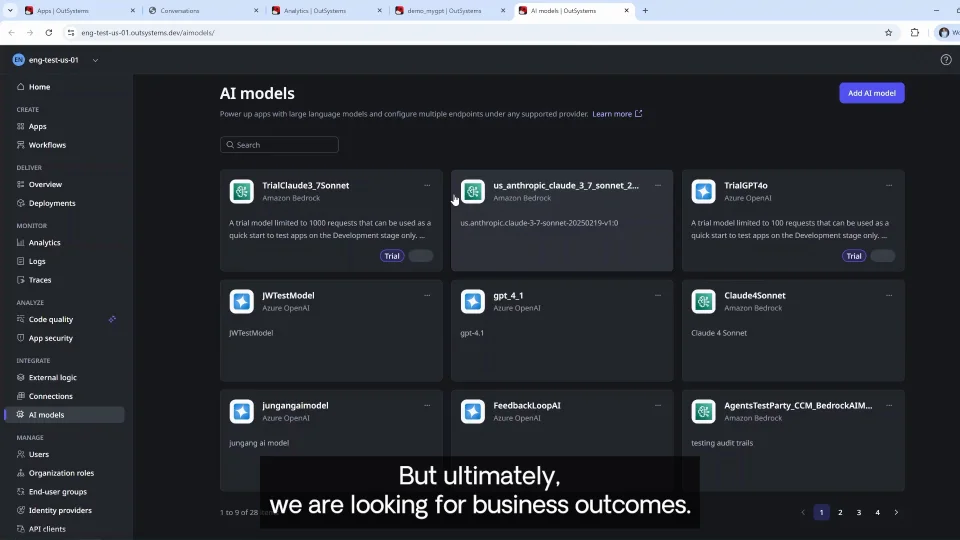
In this video, Goncalo Borrega, OutSystems VP of Product, AI & AppDev, explains what is needed to make this work.
The APAC region’s leadership was evident in its remarkable 60% rate for adopting agentic AI for software development, compared with 50% in North America and just 40% in Europe. Of the organizations surveyed, all others were either actively experimenting with agentic AI, planning to run pilot projects, or planning to integrate it into applications and workflows within the next 18 months. This proactive stance suggests high confidence in the transformative power of the technology.
How APAC companies are using agentic AI in software development
In the Asia-Pacific, the referred use cases for agentic AI varied compared with other major world regions. While 61% of software executives surveyed planned to implement agentic AI to automate internal business processes, compared with 60% in North America and Europe, the most popular use case in Asia was code reviews and quality assurance at 67%.
Although QA is a relatively low-risk area, there’s an appetite for riskier endeavors. More than half of the APAC organizations surveyed also had plans to use agentic AI for higher-value use cases. These include code generation and completion and delivering more personalized customer experiences. It appears that the approach to agentic AI is fragmented, varying dramatically among organizations and industries.
AI technology investment trends in APAC
Investment plans in AI technologies in general also reflected a fragmented trend, with 73% of APAC organizations planning to increase their investments by 11% or more over the coming year. Unlike in Europe, where 6% of respondents either planned not to increase their investment or even reduce it, only one respondent claimed their organization had no plans to invest more. Organizations throughout Asia also used AI to accelerate digital transformation, automate routine development tasks, and democratize development at significantly higher rates than respondents in Europe or North America.
AI for software development stays in-house
The study found that Asian software teams were increasingly early and enthusiastic adopters of in-house development tools and frameworks. This trend was reflected in the fact that 78% of respondents were actively developing their own custom AI agents in-house, compared with 73% in North America and just 66% in Europe.
When it comes to AI in general, two-thirds of Asian companies were building custom solutions in-house, compared with 60% in North America and just 43% in Europe. Forty-nine percent of organizations also favored implementing AI technologies via low-code platforms, taking a slight lead over 48% in North America and a significant lead over Europe’s 42%.
Investment plans across the region also reflected these ambitions. According to the survey, 25% of Asian companies expected their AI budgets to rise by more than 20%, compared with just 18% in North America and Europe.
Overall, the report’s findings show that the region is positioning itself to lead in the global AI race. Read the OutSystems and KPMG report, Navigating Agentic and Generative AI in Software Development: Human-Agent Collaboration is Here, for more insights into how organizations around the globe are adopting and using agentic AI.


