



What is low-code automation?
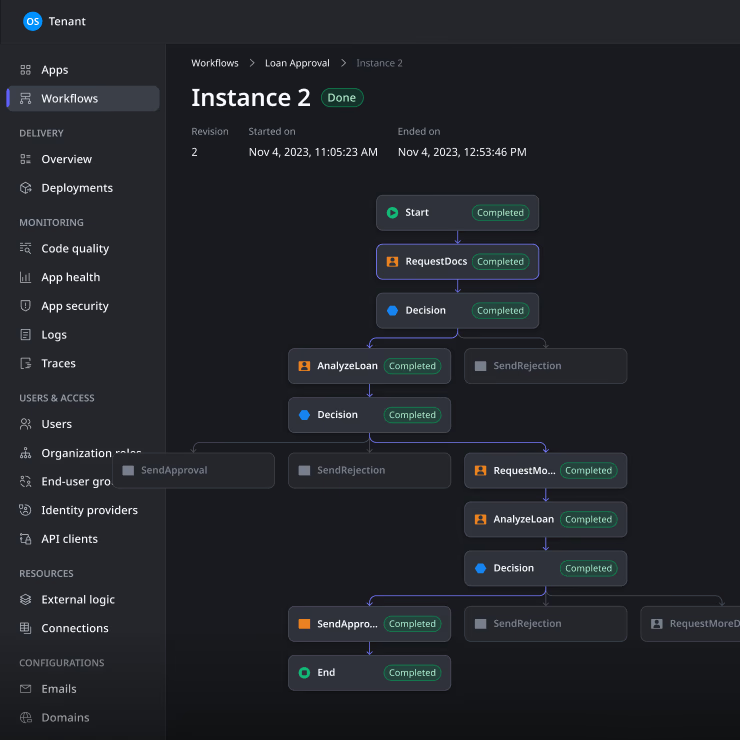
Low-code automation uses a visual development environment and drag-and-drop tools to automate workflows, processes, and application development with a minimal need for coding. With a low-code platform, organizations can reap the benefits of automation capabilities like accelerating process workflows, integrating AI-driven decision-making, and eliminating repetitive tasks.
Development teams that adopt a low-code automation approach can collaborate to build scalable solutions faster. Because they are using a low-code tool, they can invite business users to participate in automation initiatives.
While traditional automation often requires extensive programming knowledge, low-code automation simplifies the process through visual development in a drag-and-drop environment with pre-built components. As a result, businesses can create automated workflows, manage the automation of processes, and integrate with enterprise systems without the hassle of traditional automation.
Why use low-code automation?
A traditional automation tool requires complex coding knowledge, significant IT resources, and long development cycles. In addition, developers and organizations often encounter challenges such as inflexible frameworks, high maintenance costs, and scalability issues, as custom development solutions can be time-consuming and more difficult to update and extend.
In contrast, adopting a low-code automation platform provides various benefits for businesses:
- Cost-effective development: By reducing the need for traditional development, resources can be allocated more efficiently.
- Faster time to market: With accelerated development capabilities, you can deploy automation solutions faster and stay ahead of the competition.
- Increased developer productivity: Low-code automation capabilities free developers from repetitive tasks so they can focus on innovation.
- Scalability: As automation initiatives grow, you can scale them, constantly adapting to new challenges.
- Flexibility: Low-code automation platforms support adjustments without the need for redevelopment.
- Automation testing: Low-code tools simplify test automation while ensuring that applications remain secure and compliant.
Understanding automation testing
Automation testing executes checks that confirm the application works as intended, supporting both quality and performance. Because low-code tools eliminate the extensive coding needed for traditional test scripts, they reduce the duration of testing cycles and improve software quality and reliability.
Unlike manual testing, low-code automation streamlines the repetitive and complex process through visual workflows and AI-driven capabilities. Automated test scenarios can accelerate application delivery while maintaining high security standards and high performance levels.
Integrating low-code automation testing into the development lifecycle supports continuous integration and continuous deployment (CI/CD), allowing businesses to deliver software updates with confidence.
Low-code automation use cases
Low-code automation tools are transforming businesses, driving efficiency and agility across several industries. Key use cases include:
- Business process management: Low-code automation standardizes approvals, document processing, and operational workflows across departments. It enhances efficiency, eliminates bottlenecks, and ensures compliance.
- Workflow automation: From employee onboarding to invoice processing, automating workflows simplifies daily and mundane tasks, improves accuracy, and ensures process consistency.
- Legacy system modernization: Many enterprises rely on outdated systems, slowing down operations. By integrating low-code automation with existing infrastructures, you can extend the lifespan of your applications while improving performance.
- Customer service automation: AI-driven chatbots, self-service portals, and ticketing systems optimize the customer experience by resolving problems faster, which reduces wait times. This improves customer satisfaction and reduces customer service workloads.
- DevOps automation: The combination of automated testing and CI/CD lets teams build, test, and deploy applications more efficiently.
With the flexibility and agility to adapt and scale, organizations can continuously optimize their processes. Companies like Medtronic have used OutSystems to build a monitoring and triaging system, saving clinical staff time while improving patient care.
Similarly, HEINEKEN has scaled app development across more than 80 countries, using a federated development model, enabling faster innovation and streamlined operations.
Explore more OutSystems customer success stories
Looking for a low-code automation tool? OutSystems is the answer
AI-driven automation capabilities built into the OutSystems low-code platform enable businesses to accelerate digital transformation efforts, improve efficiency, and drive innovation. A leader in enterprise low-code application platforms, OutSystems offers a comprehensive automation solution that is scalable and secure.
With OutSystems, your organization can build and deploy automated workflows faster, integrate AI capabilities, and optimize business processes seamlessly. The platform provides enterprise-grade security, governance, and compliance, ensuring that your automation initiatives align with business goals. If you’re interested in seeing the platform in action, you can schedule a free demo or take a deep dive into the platform’s automation capabilities.

Frequently asked questions:
Low-code automation improves efficiency, reduces development time, enhances scalability, and streamlines workflows.
No-code automation allows users to automate processes using a visual environment without the need to write code.
OutSystems provides a comprehensive AI-driven low-code platform with workflow automation capabilities and seamless integrations.
Automation enhances productivity, reduces errors, and accelerates business growth by optimizing repetitive tasks and processes.
Automation tools help streamline workflows, testing, and integration processes while improving efficiency and reducing manual efforts.