
1. Deploying OutSystems in the cloud
OutSystems is available as a platform as a service (PaaS), providing enterprise-class cloud computing power without the hassle of managing physical software infrastructure. This is called the OutSystems Cloud, and deployment is automatic. OutSystems can also be deployed in other public clouds.
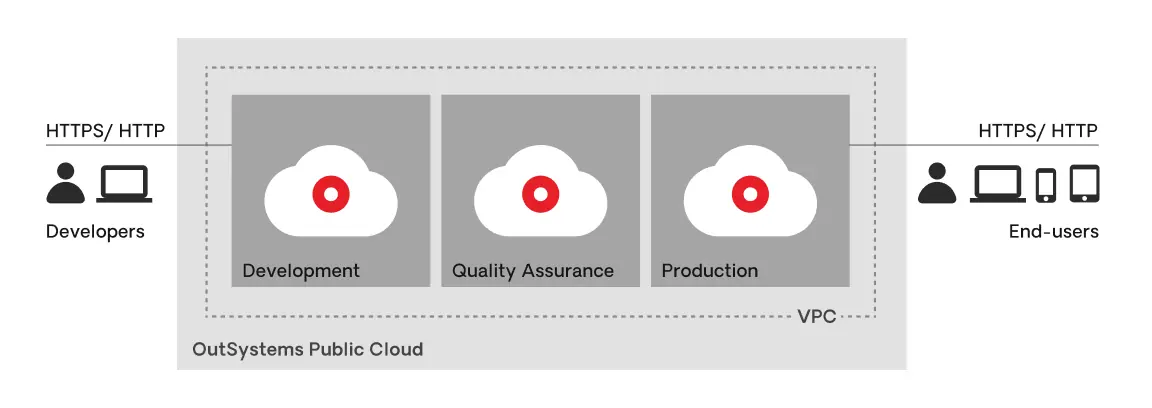
When organizations subscribe to the OutSystems Cloud, their infrastructure is automatically provisioned, configured, and tuned for high performance, security, and reliability. The physical infrastructure of OutSystems Cloud is hosted in the secure data centers of Amazon Web Services (AWS).
Check more details on OutSystems Cloud Architecture
OutSystems can also be installed in any other public cloud service provider of an organization's choice, such as Microsoft Azure, Rackspace, or VMWare.
Customers who use these clouds must install and manage OutSystems themselves. For detailed information about the platform installation requirements and process, read this article.
Table of contents
- Hybrid deployment support
- Choosing the region for an OutSystems Cloud deployment
- Cloud to on-premises portability
Hybrid deployment support
Certain editions of the OutSystems platform allow a self-managed infrastructure where a customer may choose to host OutSystems environments in different cloud infrastructures from different providers and even on-premises. This enables hybrid and multi-cloud deployment configurations.
OutSystems DevOps capabilities enable the orchestration of app deployments across environments hosted on different cloud infrastructure. In addition, by leveraging OutSystems deployment APIs, third party deployment orchestration platforms like Jenkins and Azure DevOps can be used to manage deployments across the different infrastructures.
Choosing the region for an OutSystems Cloud deployment
The choice of an AWS Region is especially important in the following scenarios:
- On-premises integration performance: Reduced distance and latency are important when organizations are integrating applications with legacy services or applications hosted in their own data centers and if they plan to engage in long-term hybrid or on-premises to cloud scenarios.
- Combination of external cloud applications and services: In scenarios where organizations are already using AWS cloud services, the advantages of deploying OutSystems in the same region include decreasing communication latency and reducing data transfer costs for other AWS infrastructures.
- Application performance for users: Organizations can provision resources closer to their users, so they have a better experience when running their applications, especially when they are concentrated in a single location.
In global organizations, how to apply these criteria may not be obvious, when both application users and internal information systems are scattered around the world. Therefore, global organizations can choose a different region for each pipeline instead of just one. These pipelines have independent databases and URLs for each environment, and organizations can also choose which applications and versions to deploy in each region, and when.
A list of the AWS Regions supported in the OutSystems Cloud is available in the OutSystems Cloud Architecture section.
Cloud to on-premises portability
OutSystems is designed for portability between cloud and on-premises data centers. Application data, metadata, configuration data, and source code are all carried through to the database, making portability much simpler than with other technologies.
At the end of a transition, all applications will continue to run as before, with all the great functionality an organization's users have grown accustomed to.
The transition to on-premises entails the following steps:
- Install the platform in the new data center.
- Ensure connectivity to all integration points and external data sources.
- Migrate the data.