



What is Agile development?
Agile software development is an iterative and flexible approach to managing and delivering software projects. It emphasizes collaboration, adaptability, and continuous improvement throughout the development process.
The Agile methodology focuses on enhancing customer satisfaction by delivering working software in shorter, incremental cycles, known as sprints or iterations.
When people talk about agile methodologies in software development, they often refer to approaches focused on:
- Working in short iterations;
- Meeting frequently for short periods;
- Visualizing their work;
- Collaborating across business and technology functions;
- Building applications as small functional components;
12 Agile principles
The Agile Manifesto provides a set of four values and twelve principles with the following goal:
“We are uncovering better ways of developing software by doing it and helping others do it.”
Since its creation in 2001, the Agile Manifesto’s following has grown and is increasingly used as a management approach and philosophy.
The four Agile Values which guide the way we work are:
- Individuals and interactions over processes and tools
- Working software over comprehensive documentation
- Customer collaboration over contract negotiation
- Responding to change over following a plan
There is value in the items on the right, but we value the items on the left more
The twelve Agile Principles provide specific ideas about how teams work when building software:
- Our highest priority is to satisfy the customer through early and continuous delivery of valuable software
- Welcome changing requirements even late in development. Agile processes harness change for the customer’s competitive advantage.
- Deliver working software frequently, from a couple of weeks to a couple of months, with a preference for the shorter timescale
- Business people and developers must work together daily throughout the projectBuild projects around motivated individuals. Give them the environment and support they need, and trust them to get the job done
- Build projects around motivated individuals. Give them the environment and support they need, and trust them to get the job done
- The most efficient and effective method of conveying information to and within a development team is face-to-face conversations
- Working software is the primary measure of progress
- Agile processes promote sustainable development. The sponsors, developers, and users should be able to maintain a constant pace indefinitely
- Continuous attention to technical excellence and good design enhances agility
- Simplicity—the art of maximizing the amount of work not done—is essential
- The best architectures, requirements, and designs emerge from self-organizing teams
- At regular intervals, the team reflects on how to become more effective, then tunes and adjusts its behavior accordingly
When to use Agile software development
Most teams benefit from using agile software development methods regardless of the nature of their work. Agile is especially beneficial when teams are creating a new product or process or when teams are focused on driving organizational change.
In some cases, a traditional waterfall approach may be best, for example, when implementing a packaged software solution that requires adherence to clearly defined, sequential steps.
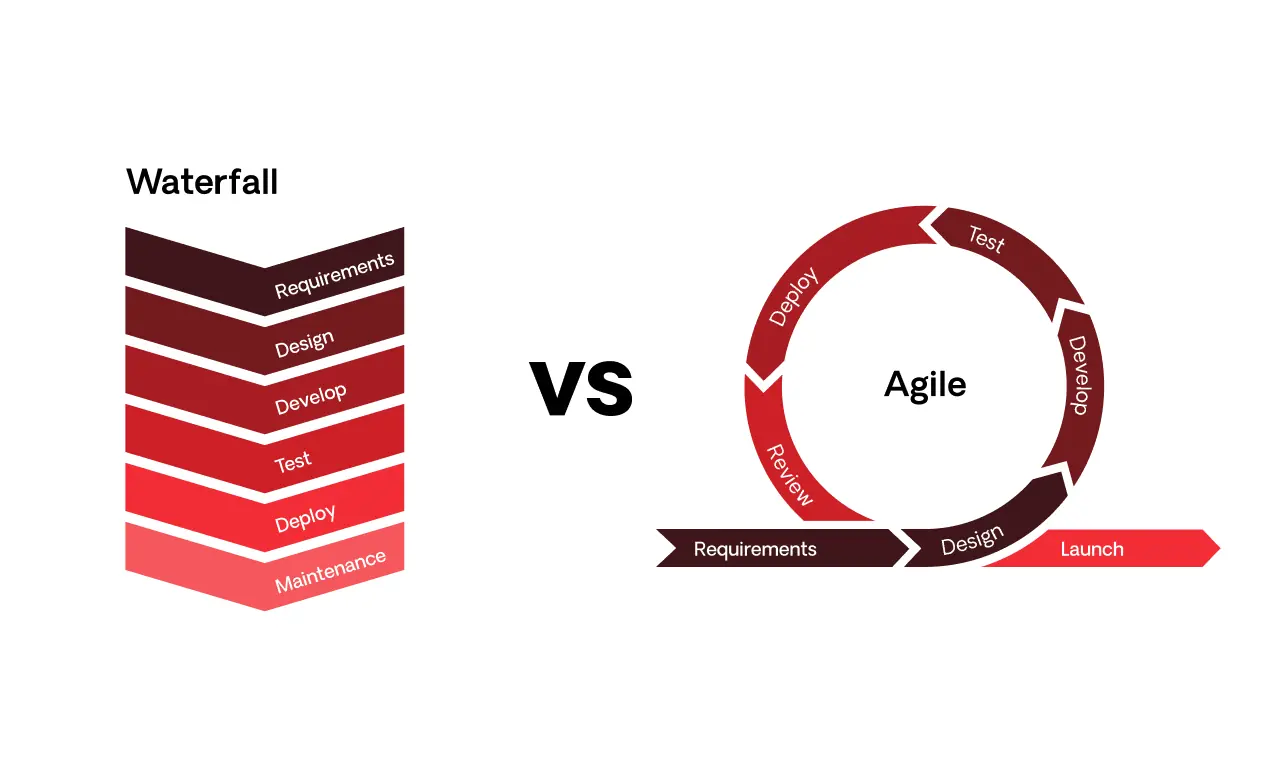
Agile Software Development vs. Waterfall
Each team should use their own knowledge, experience, and expertise to determine the best approach, whether agile or waterfall, to achieve success, but should be careful not to fall back on traditional approaches because they are easy or familiar.
Agile development vs. Waterfall
Traditional software development used a “waterfall” approach where teams would define everything at the start of a project, then build it, then give it to customers. The problem with that approach, especially in today’s fast-moving, digital world, is that by the time customers receive the product, tastes and technology often change, making products obsolete.
In contrast to the waterfall approach, agile software development methods aim to define the specific software requirements weeks or days before it is built rather than defining everything ahead of time.
Here are the key differences between the two approaches:
| Agile software development | Waterfall | |
|---|---|---|
|
Project structure & scope |
Iterative and incremental, with deliveries throughout the project timeline. |
Completes each phase of the project before moving to the next. |
|
Flexibility |
Highly adaptable and accommodates changes during the project. |
Clear and defined requirements are required at the start of the project. |
|
Collaboration & feedback |
Ongoing collaboration and continuous communication between teams and stakeholders. |
Each role has specific responsibilities. Communication happens at the predefined phases. |
|
Delivery |
Focuses on incremental delivery. |
Delivers the final product when all the phases are completed. |
|
Risk management |
Reduces risks by identifying and addressing potential issues early, and in short development cycles. |
Anticipates risks upfront, which can be more challenging for more complex projects. |
Benefits of Agile software development
Agile makes life easier for teams by keeping the project flexible, collaborative, and focused on what really matters. It helps teams work smarter while keeping customers happy.
Here are some of the benefits of embracing Agile software development:
- Faster time to market: Agile methodologies rely on shorter development cycles and continuous customer feedback, testing, releasing, and iterating, reducing time to market. This helps developers improve revenue and gain a competitive advantage by getting a product to market before their competitors do.
- Increased efficiency: Agile software development works best when the development team and the stakeholders, with varying skills, communicate together throughout the project. This frequent collaboration helps to catch and address potential issues early on in the development cycle, resulting in a more efficient process with fewer errors and better quality.
- Cost-effective: Breaking down projects into smaller pieces allows for more granular budgeting, planning, and testing of each component. With a more focused and continuous approach to project planning, teams can deliver product features and functions more efficiently, avoiding waste and increasing their return on investment (ROI).
- Improved quality: By prioritizing testing and iteration, every feature or component is tested immediately after development, ensuring that no issues go unnoticed. Developers can identify problems earlier in the agile development cycle, where they can be fixed more efficiently than if they were left undetected until the product's release. This results in better quality products and more satisfied end-users.
- Adaptability and flexibility: Agile development involves frequent reassessment and adjustment. Because iterations take place frequently, changes can be made when needed, even if the product is close to completion, ensuring that the development process is always aligned with the product goals and expectations of customers.
Agile software development methodology
Teams adopt a wide range of strategies and approaches to implement an agile software development methodology, and call themselves “agile”. However, in the case of software development, people frequently use these terms incorrectly.
They confuse the broadly defined values and principles that guide our behavior in the Agile Manifesto with specific frameworks, like Scrum and Kanban, or customized approaches that bear no resemblance to Agile.
The real value and beauty of Agile software development is that there is not a single, prescriptive guide or framework for digital teams to follow to achieve agility. Agile is not a single book or training course that will magically transform your team.
While many great frameworks and methodologies exist to help you along the way, teams can find their own agile software development process and adapt it to meet the unique needs of their organizations, industries, and customer needs.
What is an Agile framework?
An Agile framework is a structured set of practices, principles, and guidelines that organizations use to implement and apply Agile principles in their software development projects.
These frameworks provide specific methodologies and processes for managing and delivering software incrementally and iteratively, emphasizing flexibility, collaboration, and continuous improvement.
Let’s take a quick look at each of these frameworks.
Scrum
Scrum is a popular framework for solving complex problems and providing a structure for teams to deliver high-value software products. Scrum describes a set of roles, events, artifacts, and rules that help teams organize and execute their work.
This framework is one of the most popular for agile teams. Newly formed Agile teams frequently start with Scrum because it defines an easy-to-understand framework for defining and organizing teams.
However, building a high-performing Scrum team takes time and effort to understand and implement the principles in order to maximize the value of the framework. As the Scrum Guide states, Scrum is lightweight and simple to understand but difficult to master.
Kanban
Kanban is not a methodology or framework; however, teams frequently use elements of Kanban to improve their performance.
Kanban is a Japanese word meaning “signboard”. The “Kanban Board” is widely used by Agile teams to visualize and provide transparency of the team’s work. Each work item is typically represented by a card, sometimes with a user story, requirement, or task, with specific information about the work to be done.
Kanban is based on five principles:
- Visualize the workflow
- Limit work in process
- Manage the flow of an item through a system
- Make process policies explicit
- Improve collaboratively
In addition to visualizing their work on a Kanban Board, teams focus on limiting the work in progress per person and team to set limits to reduce the inefficiency of multitasking and context switching.
Scrumban
As its name implies, Scrumban takes parts of Scrum and Kanban to form a hybrid approach. Often, Agile teams start with Scrum and apply Kanban principles on top of it to improve performance and efficiency. Scrum provides the team, event, and artifact structure while Kanban supplies techniques for improving the flow of backlog items through the process.
Implementation of Scrumban can vary widely. For example, some teams may use the team and artifact structures of Scrum, but modify the events in Scrum and eliminate the strict timebox definition. Likewise, teams may choose to use traditional estimation techniques, like planning poker, while others, working outside the timebox construct, may use high-level estimations.
Scrumban is often viewed as a natural progression from the more structured approach defined in Scrum to the self-organization fostered by Kanban.
Lean Agile (lean software development)
Like Kanban, Lean Agile is not a framework itself. Lean Agile principles are often used in conjunction with Scrum, Kanban, and other techniques to improve the efficiency and performance of agile teams.
A key goal of Lean Agile is to improve efficiency by removing waste from the Agile software development process.
Lean development is based on seven principles:
- Eliminate waste
- Amplify learning
- Decide as late as possible
- Deliver as fast as possible
- Empower the team
- Build integrity in
- Optimize the whole
These principles provide Agile teams additional tools, techniques, and perspectives for improvement. Teams, at all levels of Agile maturity, benefit from applying Lean Agile techniques. For new or maturing teams, principles like deciding as late as possible and empowering the team are important foundations on which to build.
Extreme Programming
Extreme Programming (XP) is a development methodology focused on building in short development cycles to reduce the cost of changes in requirements. XP emphasizes customer satisfaction and defines practices for developers to accommodate changing customer needs to maximize value. Most of all, XP emphasizes teamwork and enables key stakeholders: managers, customers, and developers to work together to deliver great solutions.
Extreme programming is based on five values: simplicity, communication, feedback, respect, and courage.
The number of agile teams using XP exclusively is relatively small, but many of the functional and technical practices Kent Beck and others defined in XP are widespread. As a result, agile teams frequently use Scrum, for example, to organize their teams, events, and artifacts, while using XP rules to drive their product implementation.
Building high-performing Agile teams
Building high-performing, customer-focused Agile teams starts with finding individuals with the right mindset to succeed with Agile software development. Team members on a high-performing Agile team answer an emphatic “yes” to the following questions:
- Are you flexible and open to change?
- Can you collaborate across functions?
- Can you learn continuously?
- Do you have a level of trust?
- Can you communicate openly and honestly?
- Are you comfortable being part of a team?
Before starting a project, take time to find the best individuals who have the right mindset so you can quickly turn them into a high-performing agile team.
Then, it’s critical to define, as a group, your shared goals and expected way of working based on agile principles. With that framework in place, teams can start their Tuckman’s Stages of Group Development.
As they evolve through the Forming, Storming, Norming, and Performing stages, agile teams share many similar characteristics and have found ways to:
- Understand and adapt the agile values and principles;
- Build self-organizing teams; let the people doing the work define how to do the work;
- Regularly stop to reflect on how to improve their process, collaboration, and quality;
- Create an environment where collaboration includes business, non-technical, and technical points of view;
- Have the discipline to keep things simple and not build things that are not needed.
To support their evolution from Forming to Performing, agile teams need to define team practices like: ways of working, technical practices, and scaling strategies. Agile teams frequently use one of many existing frameworks to support those practices or choose to define their own practices to meet their unique needs.
Developing a deep understanding of your current frameworks is key, but remember that achieving agility goes beyond mastering narrowly defined activities.
To achieve the real value of Agile, teams need to understand the unique qualities of each team, organization, product, and project to determine the best approach to a given product development assignment. Agile teams need to look broadly at the frameworks, methods, and tools available and apply those to current circumstances to stay intensely focused on the goal of achieving customer value frequently.
Agile at OutSystems
OutSystems has developed its own Agile Methodology, which uses a variety of techniques described in this article. OutSystems’ approach has evolved over many years and, while based on Scrum, is not pure Scrum. The OutSystems Methodology is specifically designed to address the specific needs of development teams working with a modern app dev platform in order to maximize the benefits of the technology.
Useful resources


Agile software development frequently asked questions
Both Agile and iterative development are approaches in the software development lifecycle. However, they have different methodologies and practices. While Agile focuses on flexibility, continuous feedback, and customer collaboration, iterative development focuses on repeated cycles of planning, design, and testing, with moderate flexibility and customer involvement.
Agile is an approach to software development and organizational management that enables teams to respond to change by learning and adapting quickly. On the other hand, Scrum is defined by the Scrum Guide as a framework within which people can address complex adaptive problems, while productively and creatively delivering products of the highest possible value.
DevOps has its origins in Agile software development. DevOps took root because organizations were bogged down with slower releases, limitations due to factions, and software that didn’t meet expectations or quality, despite the Agile goal that iterative development would lead to faster releases.
Adaptive Software Development (ASD) is considered an Agile framework that focuses on iterative and incremental development, continuous learning, and dynamic adaptation, making it well-suited for projects with evolving requirements and unpredictable environments.