



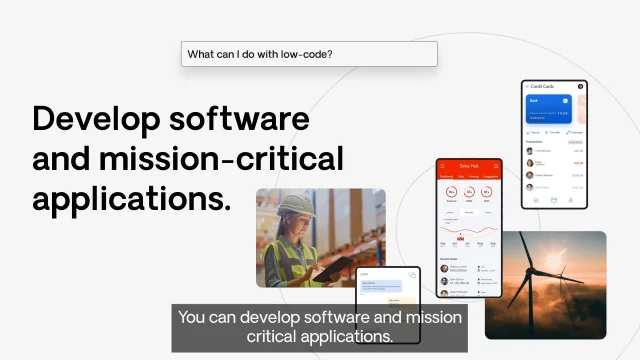
What is low-code?
Low-code is a software development approach that enables developers to create applications with minimal hand coding.
It’s designed for both professional developers and business users (also known as citizen developers), making application development more accessible, collaborative, and scalable. With low-code, organizations can launch software in weeks, not months, without compromising on quality or customization.
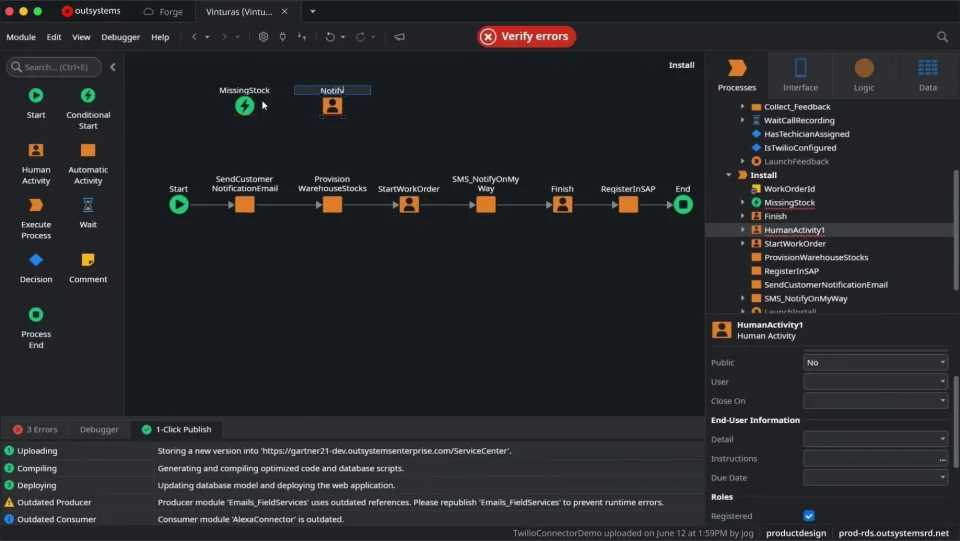
Because of its visual development capabilities and automation, low-code enables developers to create complete applications with modern user interfaces, integrations, data, and logic much faster than traditional development.
Another term often associated with low-code tools is no-code, which uses visual development but requires no programming skills to build apps. Let’s understand the key differences.
What is a low-code platform?
Low-code platforms are software development tools that provide a visual language and drag-and-drop interface for building applications, along with pre-built components and templates. This way, they enable developers to build applications with less manual coding and allow for rapid application development.
Low-code development vs. no-code: What's the difference?
Low-code is for building scalable, complex apps with some coding. No-code is ideal for building simple applications with no coding at all.
Essentially, five characteristics set apart low-code development and no-code:
- Technical expertise and target persona
- Customization and flexibility
- Development speed
- Scalability
- Use cases covered
Low-code typically offers more flexibility and customization options than no-code. Some advanced low-code platforms allow developers to add features with pro-code. They are more scalable and can manage complex situations better. They can meet complex app needs and manage larger amounts of data.
No-code platforms provide an even more simplified interface and are designed to be accessible to users with no technical background. Unlike low-code, no-code development is less flexible and has limited customization capabilities. They’re also less scalable, making them more suitable for simple, department-level applications.
Learn more about low-code vs. no-code
What’s the difference between low-code vs. high-code?
The following comparison table highlights the key differences between traditional development and low code:
| Low-code | High-code | |
|---|---|---|
|
Development speed |
Significantly faster due to visual development tools and pre-configured components. |
Slower due to the need for extensive hand-coding and testing. |
|
Accessibility |
Accessible to a wider range of users, including business analysts and citizen developers. |
Requires specialized coding skills, making it less accessible to non-developers. |
|
Flexibility |
Allows for some custom coding to enhance and extend functionality. |
Offers maximum flexibility and control over the application’s functionality. |
|
Collaboration |
Promotes collaboration across departments by making development more intuitive. |
It can be more challenging to collaborate across departments because of technical complexity. |
|
Maintenance |
Visual nature and modular components make it easier to maintain and update applications. |
More complex and time-consuming to maintain and update applications. |
Why low-code development?
With their visual approach to building applications, low-code platforms reduce the need for manual coding. It allows developers and tech-savvy business users to create apps using drag-and-drop tools, reusable components, and built-in automation.
In the 2025 State of Application Development survey, 74% of organizations plan to build 10 or more apps by 2026. To accomplish this successfully, businesses will adopt technologies such as AI-driven development and low-code platforms.
The result? Faster development cycles, more collaboration between IT teams and business, and the flexibility to scale and customize as needed.
Why does it matter to you:
- For IT leaders: It means faster delivery and a reduced backlog without compromising security or governance.
- For architects and developers: It means fewer repetitive tasks and more time for high-impact coding and strategic projects.
- For business users: It means the power to solve problems and launch applications without waiting on development cycles.
When to use low-code?
Businesses crave adaptable solutions now more than ever. Development teams face a lot of pressure to meet rising customer expectations and speed up digital transformation efforts. A recent survey conducted by Forrester revealed that the low-code market will reach $50 billion in revenue by 2028. The need for new business solutions is not slowing down.
Low-code accelerates and removes the more tedious and complicated aspects of software development. Thus, it helps organizations overcome many of the hurdles of traditional development.
From a use case perspective, the best low-code development platforms can be used to create many types of applications. These include pixel-perfect B2X mobile apps, web portals, and employee experience apps and APIs that connect legacy systems. These are just a few examples of what you can build with low-code.
Low-code platforms like OutSystems feature a visual development environment (IDE) for modeling business logic. They offer pre-built components, templates, and automatic integration capabilities for smooth app development, providing many business benefits:
- Increased agility
- Maximized productivity
- Improved customer and employee experience
- Increased collaboration between business and IT teams
- Higher retention of developers
The integration of AI with a low-code platform brings further benefits by enhancing both productivity and innovation in the development process:
- Intelligent automation: AI-driven automation tools can identify repetitive tasks and automate them, reducing manual effort and accelerating development.
- Predictive analytics: Artificial intelligence provides predictive insights that help developers foresee potential issues and optimize app performance.
- Enhanced user experience: AI algorithms can analyze user behavior and preferences, allowing for the creation of more personalized and user-friendly apps.
- Natural language processing (NLP): Enables the platform to understand and interpret user requirements more accurately, streamlining the development process.
- Continuous improvement: AI continually learns and adapts, providing ongoing improvements to development processes and application functionalities.
Explore the main benefits of low-code development and its impact on customer experiences
The OutSystems platform for low-code app development
OutSystems stands out in the low-code development arena, having been recognized as a leader by Gartner in their Magic Quadrant report for Low-Code Application Platforms (LCAP), and ranked #1 in the Custom Application Development Use Case.
"It’s not just about speeding up development; OutSystems empowers us to compete regionally and globally and stay ahead of other insurers. It's a game-changer."
Luís Colaço Head of International IT
Fidelidade

Fidelidade
With advanced tools designed for diverse users, and the possibility to take advantage of AI capabilities, the OutSystems low-code platform simplifies team collaboration and ensures the development of mission-critical applications, offering benefits such as:
- Speed: OutSystems enables rapid app development, allowing businesses to accelerate their response to market changes and customer expectations.
- Customization: Unlike many other platforms, OutSystems' low-code doesn't limit developers. It offers simplicity for beginners and depth for experts.
- Scalability: Whether you’re a start-up or a global enterprise, OutSystems can scale to any business's demands.
Experience the future of software development with the OutSystems low-code, or take the platform for a spin in our free trial.
This page was authored by Forsyth's low-code insights and expertise


Low-code development frequently asked questions
Low-code platforms enable accelerated development and help developers eliminate waste and overhead. This way, dev teams can build more apps without losing code control.
In this article, learn how IT leaders are using low-code development to reduce app backlogs.
No, low-code will not replace developers. Rather, low-code tools should be seen as a complement to traditional development. Read more in this article about a low-code career.
Low-code automation uses visual programming to develop apps. It automates repetitive tasks and optimizes business processes, with minimal hand coding.
Low-code apps are applications that are created using low-code development platforms.
The best way to learn low-code development is by visiting the resources low-code providers offer. Most low-code vendors offer extensive, free training to make developers proficient in their technology more quickly.
You can start by exploring the OutSystems online learning. The training material varies from tutorials to webinars and courses can help you understand the platform's functionalities.
An open source low-code platform combines low-code development with open source software.