AI-driven development with OutSystems Mentor
Last week, we launched a feature of OutSystems Developer Cloud that represents a vision of the future of software development. It also embodies one of the main reasons I decided to join this company.
OutSystems Mentor is the industry’s first GenAI-powered digital worker that supports the entire software development lifecycle (SDLC): from design to delivery to ongoing maintenance.
Okay, that’s a mouthful. Let me describe it another way.

What OutSystems Mentor does—an analogy
What OutSystems Mentor does for application development is like what computers have done for writing.
Can you imagine, now, today, needing to communicate something in written words—like hey!, this blog—and not having the everyday tools you usually use to do such a thing?
No screen; you must use paper. No keyboard; you must use a pen. Or, you could try a typewriter, but that means no backspace key; you must use white-out. And if, for some reason, the first version of your draft doesn’t hit the mark in the right way (much like this blog, by the way, now in its third major revision)—well, there’s really no way to efficiently delete major copy blocks, restructure its organization, or keep some snippets but trash others. Instead, you must crumple up that used paper, find a new one, and start fresh, either with a pen or your typewriter. By the end of your first draft, you’ll have a full wastebasket, an empty bottle of white-out, and a hand cramp. Also, you still need to consult the dictionary for a spell-check.
You’ll get there eventually, of course. That blog will be written, and your final outcome might even be (if you’re lucky!) just as good as it would have been if you had started it on a computer. But only because you spent so much time and effort on generating that initial draft, iterating on it until you were happy with it, and then validating its readiness to be shipped off for publishing. Also: In all the time you took doing that, you got requests for 5 additional blogs…so now you’ve got a blog backlog.
You see where I’m going with this.
I joined OutSystems because this team has a vision for what application development is going to become. The release of OutSystems Mentor is the beginning of that future. Just as computers helped us fundamentally redo how we deliver a piece of writing, Mentor is going to fundamentally redo how you deliver software.
Start with generation
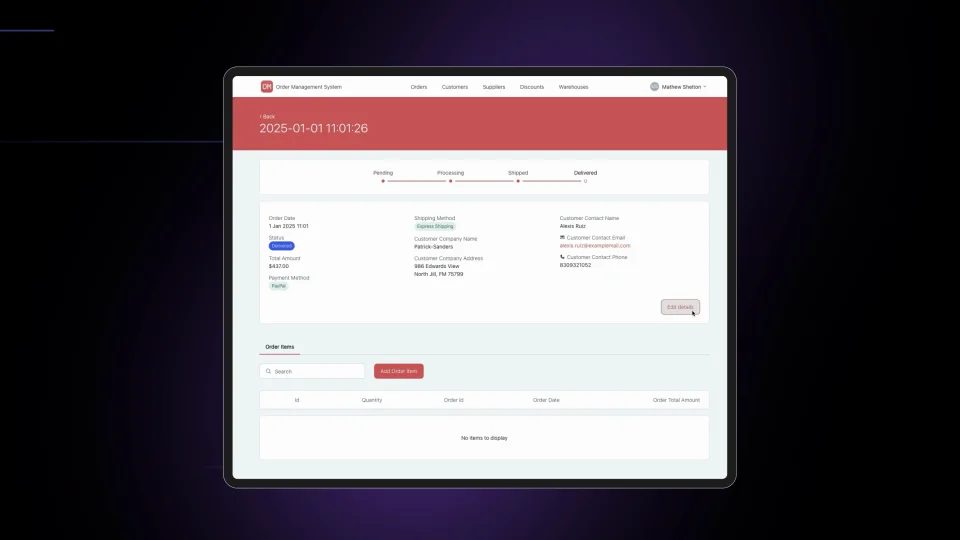
You’ve got the vision for your app—but turning it into something you can actually see and use is no small thing. What if you could go from an idea to the first version of your app in just a few minutes?
With Mentor, you can. Whether you want to start with a basic prompt (“Create an order management application”) and then fill in the gaps later, or upload a full requirements document, Mentor can take that and run with it. Based on your input, Mentor will suggest the entities from existing applications or external systems as well as the roles, attributes, records, and workflows needed to generate the app. Mentor stands out because it doesn’t just rely on user prompts—it leverages all the information you provide in requirement documents, combined with the context of your environment, to deliver accurate and relevant recommendations and outputs.
Using advanced techniques like retrieval-augmented generation (RAG), Mentor grounds its outputs in trusted sources, enabling faster development with greater confidence. For example, if you have existing data connections to external systems like SAP or Salesforce, Mentor will suggest data entities from those systems and allow you to customize them.
Once you’ve seen the suggestions, tweaked them where necessary, and feel good about the output, you move straight ahead to app generation. The AI in Mentor automatically organizes your information in useful ways. It can create tables and visual layouts, set up who can view or change different records, and build the structure of your app, including menus, screens, and how everything connects together.
So that’s the first part. Start with an idea, and use the App Generator feature of Mentor, plus a human-in-the-loop, to get to a fully built app in minutes. With everything set up, from data models to business logic to the UI, your app is ready for the next phase of its lifecycle.
Improve with iteration
Getting to an MVP or working prototype can be the biggest hurdle to overcome in application delivery. But now that you’re there, iteration becomes critical. Once your app is generated, it’s time to get to know the App Editor feature of Mentor, which is what takes you from a V1 to a production-ready app that can scale to be everything you need it to be.
Once the app is generated, Mentor takes you to App Editor to analyze its structure and data model and offer smart recommendations about how to improve it. If you see a change you need to make, don’t worry about how it might impact the rest of your application or system. You can make that change once, and Mentor has the rest covered, automatically checking and fixing dependencies before moving the application to a new valid state.
For example, imagine a scenario where you run an MVP by business stakeholders and discover you need to add an entity for a different OutSystems application in your landscape. Not only will that entity be added, but attributes that reference it can also be created in the existing entities. And, if you need to see what other app that entity came from, all you need to do is hover over its associated icon.
Mentor apps leverage the full power of the OutSystems platform, including robust governance and security, scalability and extensibility, and seamless DevOps integration. If you need additional editing and customization options beyond what App Editor uses generative AI (GenAI) to recommend, you can easily jump into ODC Studio, the IDE for OutSystems Developer Cloud, to make those changes.
Any changes made in ODC Studio are seamlessly reflected back in App Editor, and you can continue refining your app with AI-driven suggestions. This seamless workflow ensures that teams can maximize productivity, maintain consistency, and achieve the perfect balance between speed, customization, and innovation.
In short: the App Editor feature of Mentor gives you the tools you need to safely and quickly iterate on your generated app without the risk of introducing instability.
Validate with quality checks
As a last step before deploying to production, Mentor provides the sanity check you need to feel confident in what you’re about to release. AI double-checks to make sure that coding best practices have been followed, and even gives you a real-time dashboard that measures the quality of that code.
Plus, you can also double-check other critical aspects of your applications—such as architecture, security, performance, and maintenance—all with the help of Mentor. And once your app is in the OutSystems production environment, Mentor proactively and regularly checks for issues that might suggest a compromise in quality or security.
So, here you are: a production-ready, scalable app delivered in significantly less time than it would have taken you to deliver in any other scenario, whether that is traditional code or traditional low-code.
And it all started with a prompt.
Are you ready for the Generative Software Cycle?
It’s pretty bold to declare that OutSystems Mentor is going to do for application development what computers did for writing. But as someone who experienced that first transformation and now has played a very real part in this second one, I don’t think it’s too bold. I actually think it’s a pretty good analogy.
When we first previewed OutSystems Mentor back at the ONE conference in October 2024, our CEO, Paulo Rosado, unveiled the concept of the Generative Software Cycle: a reimagination of the traditional software development lifecycle that lets GenAI do the heavy lifting, while the developer—the creative—produces the art. That has been the OutSystems idea for some time, and it’s the reason we’re the low-code platform ranked #1 in vision. I couldn’t be prouder to be part of that vision.
But you know what I’m even more proud of?
One day, OutSystems Mentor isn’t going to be visionary. One day, OutSystems Mentor is just going to be…the way you deliver applications.
The Generative Software Cycle is here, and Mentor is kicking it off. Join us, won’t you?