Webinar: Practical GenAI Applications
These days, every company—especially large ones like Bosch—is exploring what they can do with generative AI. I mean, if someone promises you a tool that can boost productivity, improve efficiency, and reduce costs, wouldn’t you take it?
When it comes to app development, the potential of AI is huge. Studies show that with tools like Copilot, developers can write code in half the time and refactor it two-thirds faster compared to traditional methods—although those same tools are also correlated with increases in rollbacks.
The only technologies that come close to that development speed are low-code/no-code platforms.
Does this mean that low-code’s doomsday is near? No. I believe that low-code and GenAI will continue to merge together and fundamentally transform how we code, but there's still much to be done in this field before it becomes a reality.
Anyway, most tech companies are looking at how to integrate GenAI into their products and join this AI trend, which means the software development approach will change, but not necessarily the tools or vendors. It might be just an evolutionary step.

Why we brought in low-code in the first place
We implemented the OutSystems low-code platform to give our business units the autonomy to build their solutions, driving innovation themselves while supported by central IT with operations and governance.
As you may know, Bosch is a huge manufacturing company with almost 430.000 employees in 60 countries, producing power tools, home appliances, and equipment for the automotive business sector, as well as industrial, energy, and building technologies. As such, we have an equally large central IT responsible for delivering digital solutions to our business units.
However, due to budget and capacity constraints, the IT department cannot meet all demands for digitalization and automation, so it must prioritize activities with a higher impact or return on investment. The business units were frustrated with this situation and started to look for alternatives on their own, leading to a lot of “shadow IT.”
As a strategy to enable the business and make them partners of central IT, Bosch came up with the “Citizen Development” program, adopting a low-code platform which central IT operates, but which also allows the business to work on innovation and digitalization in a structured way without central IT bottlenecks.
Insights on low-code plus GenAI instead of just GenAI
With the current state of GenAI, we can build nice use cases for specific needs, but several limitations remain for creating and deploying a fully working and maintainable enterprise-grade application.
The thing is, writing code to build an app is just a small part of the development process. Everything that comes after is a lot more difficult, and GenAI alone cannot manage the complete software lifecycle and continuous development right now.
Essentially, from my view, there are four reasons why low-code, and in particular OutSystems, is still the right choice for us:
1. Organizational context
As mentioned, we adopted OutSystems to decentralize app development while ensuring IT governance. While GenAI can speed up app development, it generates generic code that may not align with our specific requirements, systems of records, integration and architecture guidelines, or security standards. Software developers still need to ensure everything is properly integrated; otherwise, we’re just feeding an even bigger shadow IT monster.
2. Security and compliance
It probably comes as no shock that security protocols at Bosch are very strict. We have a zero-trust policy, and frankly, I’d be surprised if a hacker could get into Bosch’s systems (and no, this is not an invitation). Unsurprisingly, AI can easily generate errors and replicate existing security issues from open-source projects. For this reason alone, AI without guardrails is not an option for Bosch.
3. Transparency
It’s funny because one of the most common reasons developers don’t trust low-code tools is that they see them as a black box. They don’t know what’s happening under the hood. To be honest, I, too, was skeptical at first; it seems that it promises too much. But, at least in the case of OutSystems, it generates real code, and we can bring in our code to Service Studio, so we’re not limited to what the platform offers.
The same doesn’t happen with GenAI tools. I have no way of knowing why it took a certain approach to developing my app. So, a good part of the time I gained from the accelerated development, I now have to spend analyzing what AI implemented to ensure it was done correctly and compliant with my company’s best practices.
4. Maintenance
Traditional development approaches have always struggled with continuous development. That’s why peer reviews and extreme programming were created—processes that could be easily replaced by AI-assisted programming.
As I mentioned, today’s GenAI tools are good enough to answer simple prompts, but they aren’t ready yet for everything beyond that. Developers can't easily evolve an app without breaking what’s been done before. Furthermore, GenAI tools don’t promote reusability because they generate code to respond to a specific prompt without any larger context about how that code fits into the bigger picture of the company’s landscape.
Why do I believe OutSystems is on the right track?
Looking at the complete software development lifecycle, OutSystems is ahead of the curve, with built-in version control and impact analysis, CI/CD, monitoring, and user feedback management. Additionally, OutSystems is already leveraging controlled AI in this area with Mentor. It generates apps, refactors them, reviews code quality, checks adherence to architectural standards, and monitors for security and performance concerns. This is all done in seconds and with much better quality than a human would.
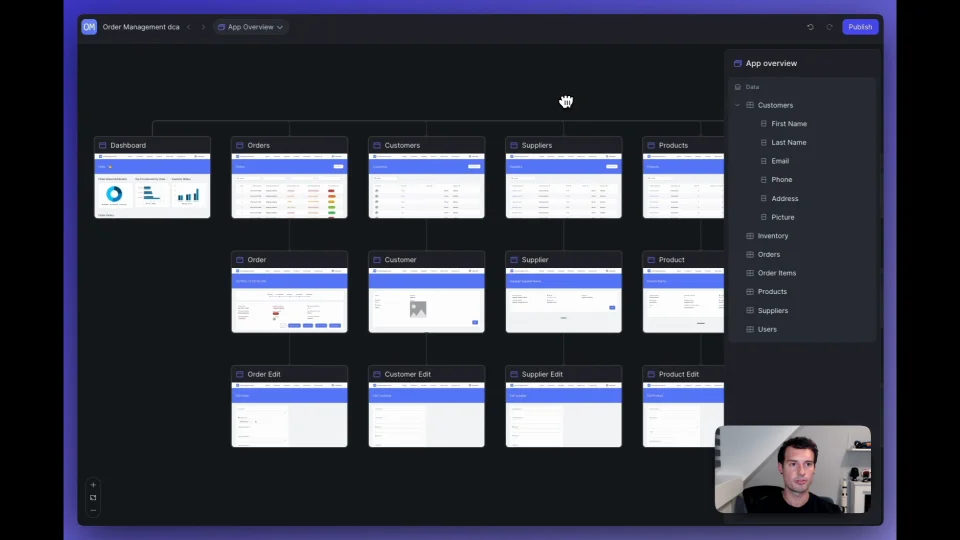
OutSystems also provides automated security validations that help us manage risk. More importantly, it generates real code that allows us to integrate our security tools to ensure apps comply with our standards. When we use their AI features, we can do it with 100% confidence that we’re getting the AI benefits without the AI risks.
Plus, OutSystems architecture allows us to rely on quality reusable components and templates (as we do at Bosch). Developers can focus solely on business logic and building the apps they need, trusting the IT Center of Excellence to govern and operate the built apps.
Final thoughts: Will AI take over software development?
There’s no doubt that AI is the future of app development. But will it replace low-code? AI has been evolving incredibly fast, and I think if this speed keeps up, both traditional development and low-code may become obsolete in the next decade. Unless they also keep up with the evolution of AI.
OutSystems has made significant strides in this direction. Tools like OutSystems Mentor and AI Agent Builder give us the productivity that pure GenAI tools promise while also addressing governance concerns and avoiding the vulnerabilities they may introduce.
Who knows what the future holds? In the meantime, and just to be safe, I’ll be polite whenever talking with ChatGPT.