Solving the Need for Agility with a Reliable Enterprise Architecture

The architecture of application development platforms determines their agility, scalability, and longevity. Having orchestrated digital transformations for over two decades as CEO of Swaran Soft, I firmly believe that the bedrock of successful applications lies in their underlying architecture. OutSystems, with its cutting-edge low-code platform, goes beyond merely acknowledging this truth. It facilitates the rapid, resilient, and future-ready development of applications.

In this exploration, I delve into the intrinsic architectural strengths of the OutSystems platform and how it stands as the preferred choice for innovative enterprises.
The key features of OutSystems for app development
At its core, OutSystems encapsulates versatility and robustness. Here's what makes it shine:
- Speed and agility: Prototyping and market introduction are swift, a crucial edge in our dynamic business landscape.
- Resilience: With advanced error handling and scalability options, it enables users to create apps that not only function but thrive.
- Future-proof: OutSystems minimizes tech debt by ensuring your apps evolve with technological trends.
OutSystems offers a flexible and cohesive frontend architecture. The platform's theming capability ensures apps can be tailored to specific audience segments—be it external users, internal teams, or partners. This modularity promotes design efficiency, accelerates time-to-market, and ensures a consistent user experience across applications.
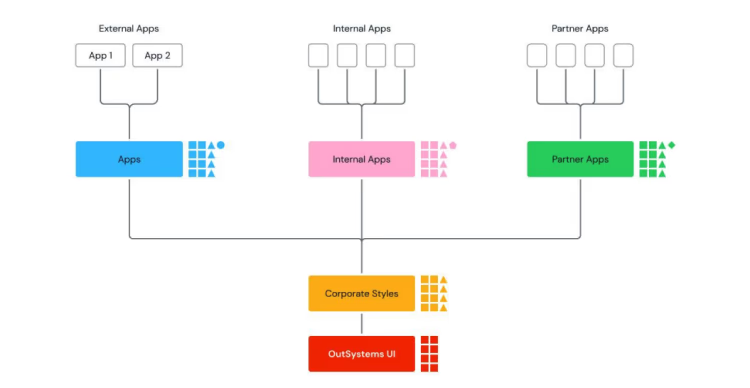
Fig 1: The OutSystems theming capability: External, internal, and partner apps
How OutSystems stacks up against common application architecture
OutSystems, a renowned low-code platform, excels across varied architectural paradigms. From the modular prowess of microservices to the structured layered approach to the real-time sensitivity of event-driven architecture and more, OutSystems seamlessly integrates and enhances application architectures. The platform's versatility reduces technical debt and accelerates time-to-market, endorsing it as a go-to solution for businesses aspiring for efficient, scalable, and adaptable application development. In this table, you can see how OutSystems not only enables you to address the main types of architecture, but the benefits it offers.
| No. | Architecture | Brief summary | Example | OutSystems advantage |
|---|---|---|---|---|
|
1 |
Microservices |
Small autonomous services that work together |
A retail app with distinct services for user, inventory, and payment |
Rapid development of individual services, easy integration and scaling |
|
2 |
Layered |
Divides application components into separate layers of responsibility |
An ecommerce app with presentation, business, and data layers |
Development and maintenance flexibility, minimal technical debt |
|
3 |
Event-driven |
Responds to action (events) to trigger subsequent processes |
A stock trading platform that acts on market fluctuations |
Asynchronous processing, real-time response, and seamless user experiences |
|
4 |
Model-view-controller |
Separates application into three interconnected components |
A blogging platform that separates database, UI, and control logic |
Clean separation, easier testing, and rapid parallel development |
|
5 |
Primary-replica |
Uses one main component (primary) to manage data and delegate tasks to secondary components (replicas) |
Database replication where the primary database is mirrored by replica databases |
Efficient data replication, synchronization, and backup capabilities |
|
6 |
Monolithic |
A single-tiered architecture wherein all components exist |
A web application with limited scalability requirements |
Simplified and dev and deployment, reduces initial technical debt |
|
7 |
SOA |
Provides services to other applications through communications protocols |
An enterprise system that connects HR, inventory, and sales |
Interoperability, scalability, and modular development |
Refactoring and ease for solution architects
Refactoring is the process of restructuring existing code without changing its external behavior. It is paramount in ensuring the longevity and adaptability of applications. OutSystems shines brightly here:
- Intuitive refactoring: The platform offers tools that streamline the refactoring process, ensuring that applications are consistently optimized for performance and maintainability.
- Visual feedback: Solution architects are empowered with real-time visual feedback, allowing for immediate identification and rectification of architectural bottlenecks.
- Modular development: OutSystems promotes modular application development. This not only aids in cleaner, structured development but also makes refactoring a breeze.
- Built-in best practices: With OutSystems, solution architects have a treasure trove of best practices at their fingertips, reducing the steep learning curve often associated with new platforms.
- Seamless integration: Refactoring often requires the integration of new components or services. The platform's design ensures that these integrations are smooth and hassle-free.
The amalgamation of these features ensures that solution architects can focus on the creative and strategic aspects of application development, while OutSystems handles the intricacies of refactoring.
Spotlight: Other architectural patterns and OutSystems
How does OutSystems fare when it comes to other architectural patterns?
Hexagonal architecture
By ensuring isolation from external agents and centering the business logic, this architecture minimizes technical debt and maximizes adaptability. OutSystems provides a conducive environment for implementing this pattern, offering clear interfaces and adaptive modularity.
Lambda architecture
Dealing with large amounts of data in real-time becomes effortless. OutSystems streamlines the processing of data, ensuring minimal latency and technical debt.
Peer-to-Peer (P2P) architecture
This decentralized model excels in distributing tasks across peers. OutSystems offers ease of integration with P2P networks, ensuring efficient resource usage and distribution.
Data-centric architecture
Focusing on data integrity and security, this architecture ensures robustness. OutSystems accentuates these principles by providing top-notch data management capabilities.
With the OutSystems Discovery component and AI Mentor, validating your architecture against best practices becomes a breeze. These tools aid in preemptively identifying and mitigating potential areas of technical debt, ensuring your applications are not just built fast and right, but also for the future.
The foundation for technology triumphs
As we forge ahead in the digital age, the architectural choices we make today lay the foundation for our technological triumphs tomorrow. OutSystems, with its emphasis on reducing technical debt, refactoring ease, and robust architectural support, emerges as the beacon guiding us toward innovation, efficiency, and sustainability.