OutSystems Agent Workbench
AI is generating buzz in every corner of business. We're seeing an explosion of AI agents popping up across different departments, each promising to make things faster, smarter, and more efficient. It’s an exciting time, but there’s a hidden challenge brewing beneath all that innovation: agent sprawl.
Suppose every team started creating their own AI agents without a clear plan. You’d quickly end up with a bunch of powerful but disconnected systems. These isolated agents, while helpful on their own, can become unreliable and inefficient when they don't work together. What’s worse, they can introduce significant risks, ultimately holding back your enterprise’s big-picture transformation goals. Without strategic management and coordination, these AI agents can hinder the very enterprise-wide change they were meant to accelerate.
In this blog, I break down what makes multi-agent orchestration so powerful, explore different orchestration patterns, and share how OutSystems Agent Workbench can help.
Single agents vs. multi-agent systems
When you start thinking about bringing AI into your workflows, one of the first questions that comes up is whether to use a single AI agent or multiple agents. This choice really depends on what you're trying to achieve.
The lone wolf: What are single-agent architectures?
A single-agent system is pretty straightforward. You have one AI agent that acts as the "brain" for a specific task, and it has access to tools and memory to help it get the job done. For example, this agent could be responsible for retrieving information and generating a response based on that information. It evaluates whether a tool, like a vector search engine or web search, is useful to solve a query or part of it. It can also check its memory to see if a question has been answered before or if it needs more information. If a query is complex, a single agent can even break it down into smaller sub-queries to improve search results.
Single-agent architectures are generally less complex, which means they’re easier to develop and manage. They don’t require coordination between agents and often use fewer computational resources. However, they may struggle with complex or dynamic tasks, lack the ability to handle diverse expertise or collaboration, and become confused by too many tool options.
The collaborative crew: What is multi-agent architecture?
Sometimes, a single agent just isn't enough. That's where multi-agent architectures come into play. These systems involve multiple AI agents working together to solve more complex problems. Often, there's a main agent that acts as the lead, coordinating the overall operation. Each specialized agent might be responsible for a specific group of tasks. For instance, you could have one agent focused on retrieving data from internal sources. Another might specialize in web searches for public information. A third may handle information from personal accounts like email. Each of these agents can be equipped with its own memory and tools too.
Multi-agent architectures excel at complex and dynamic tasks and can even process information in parallel. They allow for the use of smaller, specialized models, which can be more efficient for distinct tasks. The trade-off, however, is increased complexity in development, management, and debugging because these agents need robust communication and interaction mechanisms. They might also require more resources as you add more of them.
Choosing between a single-agent and multi-agent architecture boils down to the complexity and specific needs of your use case. Simple, well-defined tasks are most likely suited for a single agent, while complex, dynamic scenarios that require specialized knowledge and collaboration will benefit from a multi-agent architecture.
What is AI agent orchestration? Why is it a strategic imperative?
As AI agents multiply, how do you ensure they’re a high-performing “collaborative crew,” and not a bunch of disconnected "lone wolves" ? That's where AI agent orchestration comes in.
Simply put, AI agent orchestration is about management and coordination. It is especially critical when you have multiple agents working together. This agent strategy focuses on how intelligent agents interact, share information, and collectively achieve bigger business goals together. It’s about building an agentic AI system. And in this system, AI agents can act autonomously, all while giving you end-to-end control and endless flexibility.
Why is this so important right now? It's a strategic imperative for several key reasons:
- Achieve significant cost savings: Streamlining operations and automating high-effort, error-prone tasks can dramatically reduce operational overhead, cut labor costs, and grow revenue.
- Unlock next-level automation: AI agents can reason, plan, act, and evolve, which is far more dynamic than static, rule-based automation. This means you can tackle complex tasks and scale smarter, faster, and more efficiently.
- Coordinate across complex processes: Many business processes are intricate and span multiple systems and teams. With agent orchestration, you can coordinate multiple AI agents across workflows, with or without humans, to achieve critical business outcomes.
- Ensure trust and control: When AI agents are making decisions, visibility and control are paramount. While orchestration allows you to embed agents across any workflow where they deliver the most value, only sophisticated orchestration solutions also offer true insight into how those AI agents make their decisions.
- Innovate as fast as the future demands: The landscape of AI is constantly evolving. By embracing agentic architectures and agent orchestration, businesses can adapt workflows seamlessly. They can keep processes up to date and rapidly implement changes to meet any business need.
Core agent orchestration patterns and their values
So, now that we know why orchestrating AI agents is essential, let's look at some common ways these agents can be structured and managed to get work done. Think of these as blueprints for how your AI team works together.
The assembly line: Sequential workflows
In many factory assembly lines, each station completes a specific step before passing the product to the next. That's a sequential workflow. In this pattern, AI agents activate in a specific order. The first agent finishes its task, then hands it off to a second agent, which then passes it to a third agent, and so on.
Here’s a customer support example. An AI agent receives a customer query and categorizes it. Then, a second agent takes that categorized query and looks up relevant information in a knowledge base. Finally, a third agent drafts a response using that information. Each agent builds on the work of the previous one, ensuring a structured and predictable flow. This is particularly useful when tasks depend on the completion of prior steps.
The team lead: Hierarchical (supervisor–worker) workflows
In a hierarchical pattern, you have a "supervisor" agent that oversees the entire operation and distributes work to several specialist "sub-agents." The supervisor agent understands the bigger picture and assigns specific parts of a complex task to the most appropriate specialized agents.
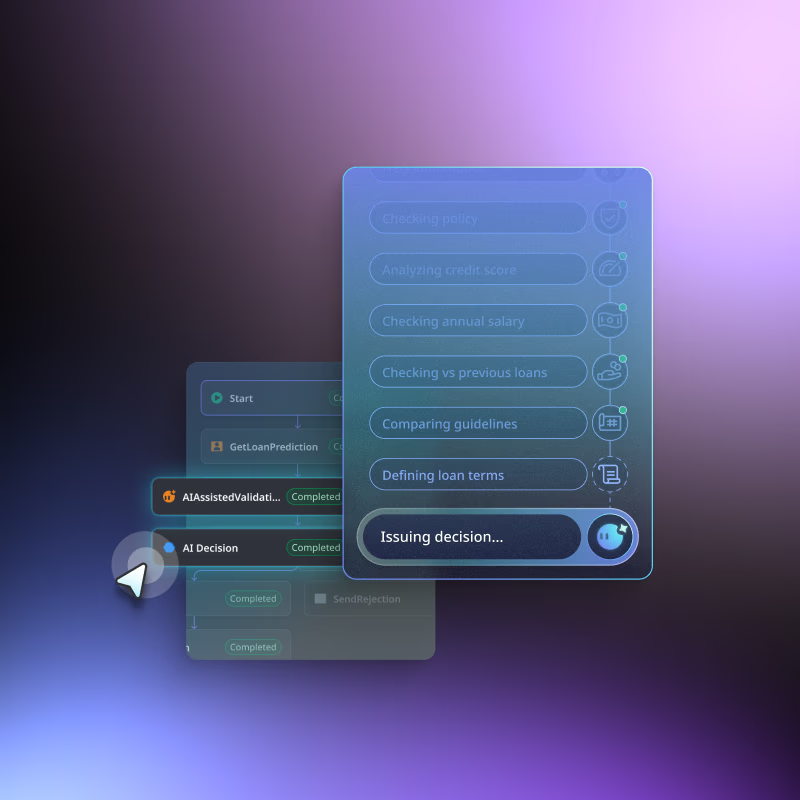
Here’s a loan approval example: A supervisor AI agent receives a loan application. It then assigns different parts of the review to specialist sub-agents. One checks the applicant's credit history. Another verifies employment details. A third assesses the possibility of major life events such as a marriage or becoming a parent. A fourth assesses property collateral. The supervisor agent then collects all the information from its sub-agents to make a final recommendation or decision. This approach allows for efficient delegation and parallel processing of specialized tasks.
The human touch: Human-in-the-loop workflows
Even advanced AI sometimes needs human judgment, empathy, or nuanced understanding. Human-in-the-loop orchestration is designed for these situations. In this pattern, the orchestrator (which could be an AI supervisor agent or the workflow itself) pauses and hands control to a human reviewer or participant before proceeding. This ensures critical decisions and sensitive tasks have the proper human oversight.
For example, in a fraud detection system, an AI agent might flag a suspicious transaction. Instead of automatically declining it, the workflow pauses and sends the flagged transaction to a human fraud analyst for review. The human can then apply their expertise, interact with the customer if necessary, and make the final decision before the workflow continues. This human-AI collaboration is crucial for sensitive or high-stakes processes.
The OutSystems Agent Workbench advantage: Enterprise-grade orchestrations
So, can you actually put AI agent orchestration into practice without the complexity? Yes. OutSystems Agent Workbench changes the orchestration game. It’s designed to help you create custom AI agents that deliver real results, streamlining operations, elevating experiences, and even growing revenue—all on the AI-powered low-code platform built for enterprise innovation.
OutSystems Agent Workbench is a complete agentic AI toolset that allows you to create, orchestrate, and govern agents with ease, avoiding patchwork tools and mounting maintenance costs.
OutSystems Agent Workbench delivers built-in, enterprise-grade capabilities that make sophisticated AI agent orchestration a reality for your business:
- Visual drag-and-drop flow design: Forget complex coding for orchestrating agents. With Agent Workbench, you can deliver complex agent-augmented apps with your existing team using a low-code approach to agent building. Easily design multi-agent workflows and patterns using a visual drag-and-drop interface.
- Deterministic and agentic workflows: You get the best of both worlds: the predictability of traditional workflows combined with the dynamic intelligence of AI agents. This means you can create and orchestrate intelligent agents for any use case—across any department, workflow, or data.
- Contextual reasoning: AI agents in Agent Workbench are designed to actively "think" throughout the problem-solving process. They can break down tasks, choose appropriate tools, evaluate outcomes, and adapt based on results and external data—enabling smarter decisions grounded in your enterprise data.
- Human oversight: For critical decisions or sensitive data, you can design multi-agent workflows with humans in the loop to ensure you maintain full control and alignment.
- Full audit trail: With built-in observability and monitoring, you can track agent reasoning, response quality, and operational costs in real-time, ensuring transparency and accountability across all AI agent activities.
- Enterprise-grade governance and security: Deploy and scale agents with the trust, security, and compliance your enterprise requires. Enforce strict access controls, guardrails, and AI usage limits to ensure agents operate safely and predictably. This helps protect against costly mistakes and supports auditability.
OutSystems Agent Workbench empowers you to build a future-proof AI foundation. You can connect and reuse AI models from leading providers and ground agents with any data across internal and external sources, ensuring trustworthy and relevant outputs. It’s about building your AI workforce, your way, with full control and no sprawl. Visit the Agent Workbench product page to learn more.