Gen Re Delivers 30 applications in Nine Months
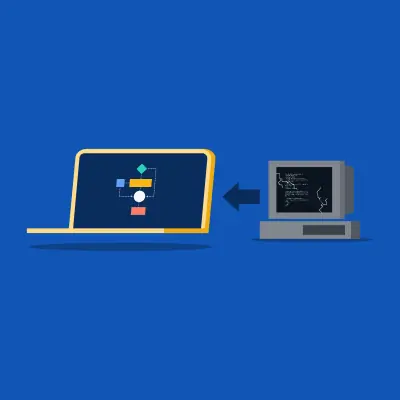
One of the most common roadblocks on the path to digital transformation are legacy applications that can no longer keep up with an organization’s needs. These applications typically rely on outdated technology that makes them incompatible with modern standards. They’re also difficult and costly to scale and maintain, and they’re more vulnerable to cyberattacks.
Ripping and replacing these systems risks disruption and data loss. Rebuilding or refactoring them using traditional development methods is a lengthy process that can significantly delay the implementation of modern business strategies.
Today, however, organizations have more options, and there are four legacy modernization trends that are becoming increasingly influential: cloud migration and cloud-native development, DevOps, artificial intelligence (AI), and low-code development. In this blog, we look at the legacy modernization trends and strategies you should consider for managing the transformation risks.

Why modernize legacy systems?
It’s a fair question. After all, if your current systems are “good enough,” why rock the boat?
For one, obsolete or outdated technology can suffocate transformation and innovation. Modernizing legacy systems enables organizations to become faster, better, stronger, and leaner. They can adapt to evolving technology and changing customer expectations while increasing operational efficiency and providing robust security.
Failure to modernize also results in technical debt, which is the cost of shortcuts taken during the development of the legacy system. The result is an accumulation of poorly designed, difficult-to-maintain code over time. This debt increases when a legacy asset is used beyond its valuable life and becomes legacy debt. All this debt increases the risk that business functions will stumble when that technology eventually fails.
Application modernization creates the flexibility and agility required to integrate IT technologies so they align with business demands. Continually reinvesting in modern technology protects the organization from costly downtime and can increase revenue, reduce risk and debt, and foster innovation.
When and how to modernize legacy systems
Organizations retain their legacy systems for several reasons. These include the high upfront costs of migrating, a lack of development capabilities and skills in-house, and the fear that change will disrupt the normal functioning of the business. But, in most cases, the real risk is not modernizing.
So, how do you do it? Start with a roadmap for addressing total cost of ownership (TCO) that is too high, technology that is too complex, or competitiveness that is limited.
Here is a broad outline of the five steps you should follow as you build your legacy modernization roadmap:
- Use data to drive decisions around implementing digitization, enabling discipline and avoiding the disruption of business operations.
- Build a roadmap for the integration of new technology and the reduction of technical debt that is compelling, incremental, and finite.
- Identify and communicate outcomes to the business.
- Find incremental wins to create a flywheel effect, which enables the momentum needed to support your long-term strategy.
- Prepare your team to adopt technology like cloud-native development, DevOps, AI, and low-code to modernize your legacy systems and optimize business processes.
Legacy modernization trends you should know
Now, let’s look at four legacy modernization trends that can help you shape your modernization strategy.
1. Cloud migration and cloud-native development
Migrating legacy applications to the cloud gives you immediate access to benefits such as scalability and usage-based pricing structures. But the real path to modernization is through cloud-native development using microservices, containerization, container orchestration (Kubernetes), and other technology to build applications architected for the cloud. Indeed, Gartner predicts that cloud-native platforms will serve as the foundation for more than 95% of new digital initiatives by 2028—up from less than 50% in 2023–because of the flexibility, reliability, and efficiency they deliver.
2. DevOps
DevOps speeds the delivery of higher-quality software by automating and integrating the efforts of development and IT operations teams. Fostering a culture of continuous integration and continuous deployment (CI/CD), automation, and collaboration, DevOps methodologies play a vital role in modernizing legacy applications while reducing risk and improving quality.
3. Artificial intelligence
By automating code analysis, testing, and performance modernization, Artificial intelligence (AI) is changing how developers create and update applications and accelerating legacy modernization. AI-driven tools streamline the modernization process, reduce manual effort, and enhance accuracy, making the transition smoother and faster. It also supports the development of cloud-native applications that improve productivity and user experience.
4. Low-code development
Like AI, low-code development drives a faster and more efficient modernization process, whether you are building cloud-native applications from scratch or refactoring. The right low-code development platform supports the other trends by enabling cloud-native development, DevOps practices, and AI-powered automation of the entire development lifecycle. Low-code also offers a phased and modular approach to legacy modernization, enforcing best practices and governance—which in turn decreases risk and disruption. In fact, Gartner predicts that by 2025, 70% of new applications developed by organizations will use low-code or no-code technologies—up from less than 25% in 2020.
Harness legacy modernization trends with OutSystems
Using the OutSystems low-code platform, companies can take advantage of these trends and modernize legacy systems as follows:
- Extend core systems with new user interfaces to support unique business processes.
- Refactor individual application components to create a flexible foundation for innovation.
- Rebuild legacy applications or build new core systems using a secure and robust cloud-native architecture.
With OutSystems, companies can reduce technical debt without risk, improve data accessibility, and accelerate business value creation. Better yet, with OutSystems, you can modernize faster, using your existing team.