2025 IDC MarketScape: Low-Code and No-Code Technologies
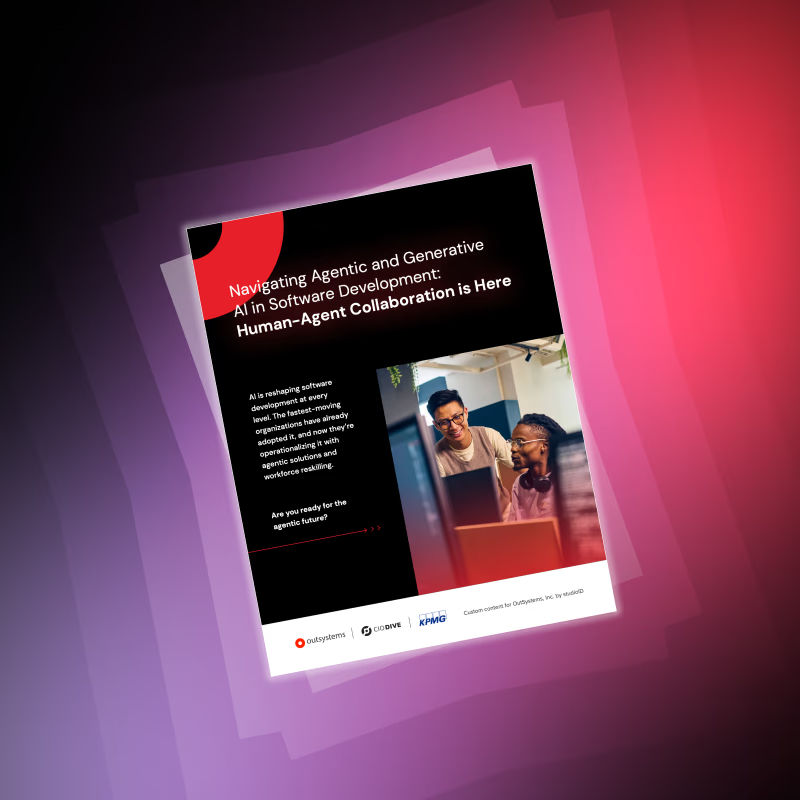
According to a new survey by OutSystems, 2025 is the breakout year for agentic AI. Enthusiasm for the technology is growing worldwide, with 47% of organizations integrating it across the software development lifecycle, along with a further 28% actively experimenting with it.
Agentic AI is a term for systems that work autonomously with minimal human involvement. Its widespread adoption leaves executives of software companies grappling with solutions to the challenges that come with it.
Top executive concerns: Transparency, security, and governance
The advantages of agentic systems are clear, such as automating internal business processes and enabling a more personalized customer experience, as Gonçalo Borrega, OutSystems VP of Product, AI and App Dev, explains in this video.
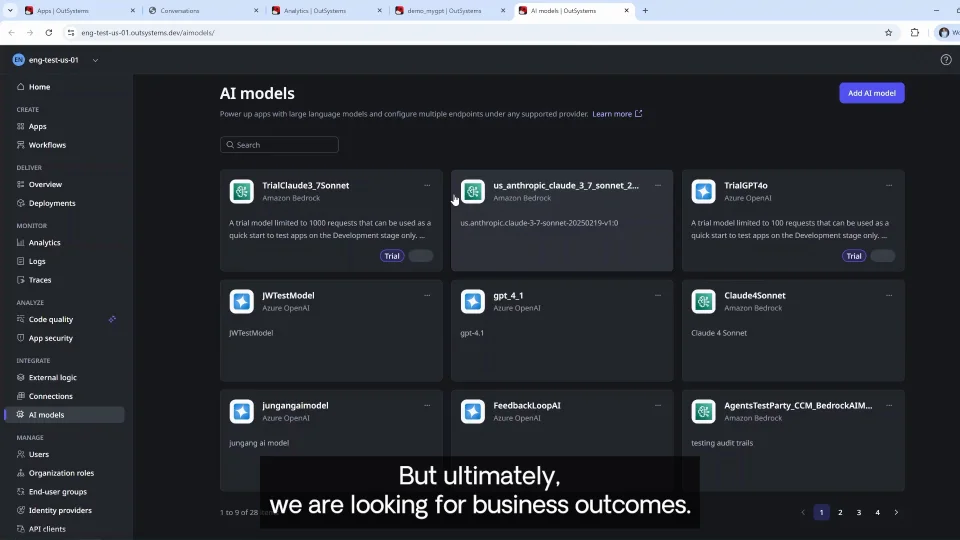
But there are also risks and hurdles to overcome. First on the list is the transparency of AI-generated decisions and governance, security, and compliance, with 64% of respondents citing these challenges.
The risks cited most often tie into the broader fear of haphazard AI adoption. After all, separate AI tools and services for application generation, agent generation, QA and testing, deployment, and business process management appear on the market all the time. As different teams adopt a new tool for only a specific function, the result is AI sprawl. This sprawl can lead to data leakage, breaches, operational inefficiency, and redundancy because the tools are not connected.
AI sprawl also exacerbates the perennial challenges of data quality and the increased use of unapproved AI tools (shadow AI).
Agentic AI is only as good as the data used to train it
Another concern is the quality of data, with 41% of respondents reporting that poor data quality is hindering agentic AI automation. And AI systems are only as effective as the data they are trained on.
Cleaning up data pipelines and ensuring integrity are universal prerequisites for the successful and reliable deployment of AI. However, this itself is a key challenge area, given that 32% of organizations surveyed cite a lack of internal expertise needed to validate the data. This reflects a growing awareness that a unified solution is needed for preparing, connecting, integrating, and validating data for AI-powered applications and agents.
Shadow AI
Shadow AI is the unsanctioned use of AI tools by employees.
It’s a concern for 27% of software executives globally. This issue was notably more prevalent in North America and Asia, where the figure rose to 33%, compared with only 20% in Europe. Naturally, the risk becomes more prevalent in organizations that lack strong governance, although 89% of organizations surveyed rate their governance and monitoring capabilities as either good or excellent.
How organizations are mitigating agentic AI risks
How are organizations clearing these hurdles? According to the survey, 57% of respondents are establishing frameworks to ensure the ethical, legal, and efficient use of AI across development processes. This meshes with the 53% of software executives who cite them as a concern. Providing education and other resources for increasing AI skills and knowledge is a popular solution with 55% of executives.
In addition, 42% are starting with small-scale projects to assess feasibility and impact before broader implementation, while 55% are providing education and other resources to equip development teams with AI-related skills and knowledge.
Adopt agentic AI responsibly and reap the benefits of transformation
By prioritizing robust governance, ensuring data quality, upskilling teams, and fostering a culture of responsible AI adoption, businesses can navigate the complexities of agentic AI. This strategic approach can mitigate risks like "shadow AI" and unlock transformative benefits, driving innovation and maintaining a competitive edge in an increasingly AI-driven world. To support this approach, however, you need a single platform that combines AI and low-code development, not a collection of AI tools.
Low-code provides the foundation that makes generative and agentic AI accessible, turning complex development tasks into visual, manageable processes. AI embedded throughout the software development lifecycle streamlines development, ensuring innovation meets control, and complex AI translates to real business value.
The OutSystems platform provides the unified environment and underlying infrastructure that allows AI agents to operate effectively in an enterprise. Teams can build applications and AI agents faster while maintaining quality, governance, and control with capabilities like Agent Workbench, which provides a framework for orchestration and governance.
To learn more about the survey and its results, read Navigating Agentic and Generative AI in Software Development: Human-Agent Collaboration is Here.