



What is cloud native?
Cloud native refers to a set of practices and methodologies used to develop applications specifically designed to be hosted and operated in the cloud. It uses microservices, containers, and continuous deployment to create applications that are agile, scalable, and adaptable.
Understanding cloud-native applications
At its core, a cloud-native application is designed to take advantage of all the benefits associated with cloud computing, such as agility, elasticity, and resilience.
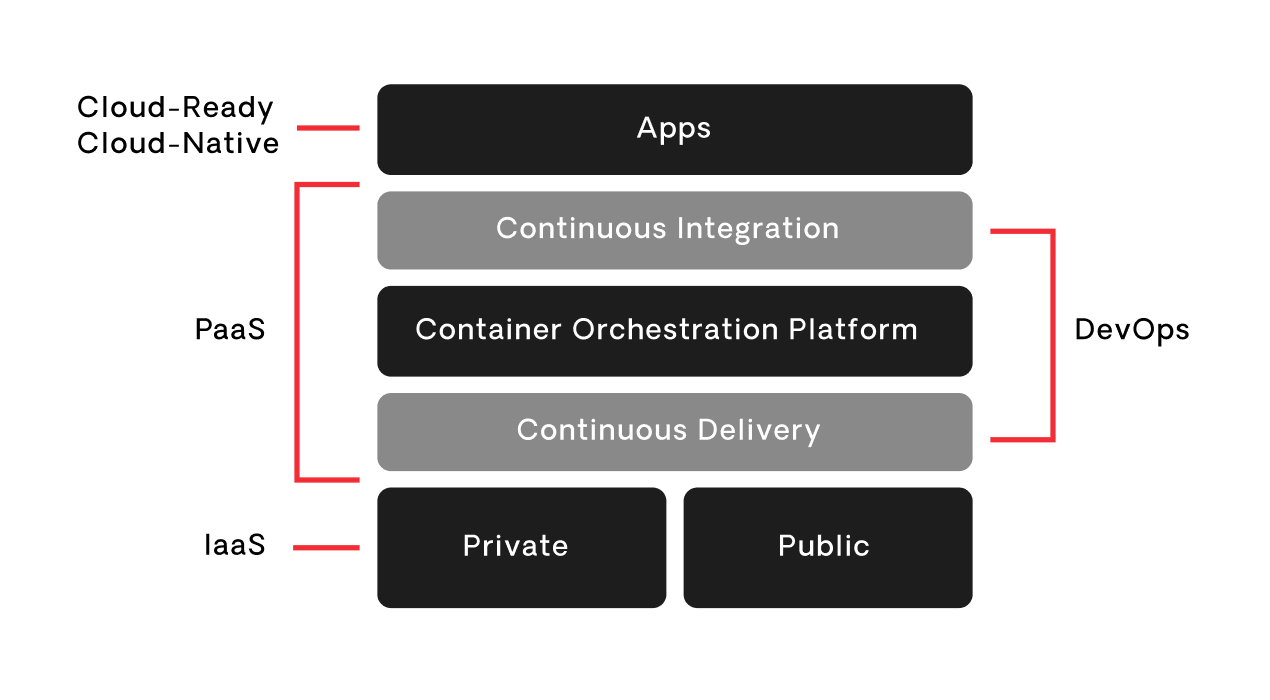
Fundamental principles of cloud native apps
- Microservices: This term refers to structuring an application as a collection of small services that operate independently, using APIs to communicate. Each is responsible for a specific business or technical domain. Modifying an application with a microservices architecture is easier because they are not tightly coupled.
- Containers: These standard units of software package up code and all its dependencies so that an application runs quickly and reliably from one computing environment to another.
- Continuous deployment: This method releases code changes to an application automatically into the production environment–and therefore users–after the updates pass a series of predefined tests.
- Serverless: In this cloud model, the provider fully manages the underlying server infrastructure, and it automatically scales and configures to meet application requirements. Developers only pay for the resources the application uses. The serverless architecture automatically removes compute resources when the app stops running.
Advantages of cloud native software development
The benefits of cloud-native development include:
- Accelerated development and releases: Microservices, modular development, and automated continuous integration and deployment (CI/CD) enable swift, incremental software deployment, enhancing overall quality.
- Cost reduction: With the cloud, investing in expensive hardware or overprovisioning resources that may not be used are a thing of the past. With serverless, you pay only for the resources you use. Plus, microservices, containers, and CI/CD can eliminate costly upgrades and maintenance associated with monolithic applications.
- Simplified management: Serverless eases provisioning, configuration, and management burdens.
- Reliability and business continuity: Cloud-native development reduces redundancy and improves fault tolerance through container orchestration, self-healing, and automated recovery. As a result, downtime is reduced, which enhances reliability and conserves resources for other IT priorities.
- Open-source standards and vendor neutrality: This ensures application portability across diverse cloud environments.
- Enhanced customer experiences: It enables the faster release and iteration of software so you can respond more effectively to customer experience feedback and changing expectations.
Cloud-native architecture explained
Cloud-native architectures combine software components that development teams use to build and run scalable cloud-native applications. The technological building blocks of these architectures are:
- Immutable infrastructure: In this infrastructure, servers for hosting cloud-native applications remain unchanged after deployment. If an application needs more computing resources, the app is moved to a new high-performance server, avoiding manual upgrades.
- Microservices and service meshes: As mentioned previously, microservices are combined to create cloud-native applications. Service meshes manage the communication between multiple microservices, which enables developers to introduce additional functions without writing new code in the application.
- APIs: Cloud-native architectures use APIs, which are used by software to exchange information, to bring microservices together. APIs state data a microservice wants and what results it can give you, instead of specifying the steps to achieve the outcome.
- Containers and container orchestrators: Containers are used to package code, and cloud-native applications can use hundreds or more of them. Managing them can be difficult. Orchestrators like Kubernetes automatically provision, deploy, scale, and manage containerized applications without worrying about the underlying infrastructure.
Building blocks of cloud native architecture
Creating cloud-native applications requires a keen focus on flexible, scalable architecture aimed at delivering optimal user experiences. This involves embracing container technologies, leveraging leading cloud infrastructure providers, and understanding scaling strategies.
Considerations when developing cloud-native applications
Transitioning to cloud-native applications involves the effective planning of architecture, skills, resources, budget, and more. Here are some of the considerations you should factor into your strategy.
Security and compliance
The unique nature of cloud-native applications necessitates robust data encryption, continuous compliance integration, and specialized cloud-native security services to address emerging security challenges.
Scaling and performance in cloud-native applications
Designing for scalability and performance requires auto-scaling strategies, performance tuning, and thorough load testing. The goal is to ensure that applications can handle varying loads while maintaining high service reliability.
Disaster recovery and high availability
Resilient cloud-native architecture involves implementing redundancy and cloud region strategies. Cloud-specific disaster recovery services are needed to ensure continuous operation.
Resource management and optimization
To manage resources effectively in cloud-native applications, be prepared to monitor them closely, make informed auto-scaling decisions, and adopt green computing practices for environmental sustainability.
Monitoring and management tools
To ensure the visibility and optimal performance of your cloud-native applications, you should adopt tools for application performance management, log analysis, and infrastructure as code practices.
Embrace innovation with OutSystems cloud-native architecture
OutSystems cloud-native architecture paves the way for groundbreaking innovation with its low-code development environment, Kubernetes integration, and comprehensive support. OutSystems Developer Cloud (ODC) transforms months of traditional development into days, ensuring high-performance, secure, and scalable applications. With OutSystems, you're equipped to navigate the intricacies of cloud-native development with ease, ensuring rapid market deployment and enduring application resilience.
The OutSystems edge
OutSystems is committed to the continuous evolution and flexibility of its platform, ensuring your applications are always at the forefront of technology and business needs.
When charting a course in the cloud-native realm, choosing OutSystems means opting for efficiency, power, and unparalleled support. Your journey to cloud native success is our expertise—let's innovate together with OutSystems Developer Cloud.


Cloud native frequently asked questions
The term "cloud" broadly refers to the delivery of various services (like storage, computing, and databases) over the internet. Cloud-native, on the other hand, is a methodology for building and running applications that fully exploit the advantages of the cloud computing model. There are cloud-based applications that run on cloud infrastructure; however, cloud-native applications are specifically designed and architected to thrive in a cloud environment.
Yes. It is built from components, design principles, and patterns that are ideal for the cloud environment, such as microservices, containerization, and dynamic orchestration. Its practices and strategies like DevOps, continuous integration, and continuous deployment (CI/CD), and agile development, are all geared towards leveraging cloud computing to its fullest potential.
Cloud-native is a broad approach that includes designing applications optimized for cloud environments, often using containers and microservices. Serverless is a specific cloud-native approach where developers build and run applications, and the cloud provider automatically manages the underlying servers and infrastructure.
The Cloud Native Computing Foundation (CNCF) is an open-source software foundation that is fostering and sustaining an ecosystem of open-source, vendor-neutral projects. It is part of the Linux Foundation and focuses on promoting cloud-native technologies, including Kubernetes, Prometheus, and Envoy. The CNCF provides governance, marketing support, and technical oversight for a broad range of projects that follow cloud-native principles. Founding members include Google, CoreOS, Mesosphere, Red Hat, Twitter, Huawei, Intel, RX-M, Cisco, IBM, Docker, Univa, and VMware.