Your guide to agentic AI: From automation to autonomy

Editor’s note: The continuous shape-shifting of AI from reactive to proactive and autonomous has broad implications in software development, both for the discipline itself and for what it is being used to build. Recently, we asked Deputy CIO and Assistant Vice President at Yale University Frank Mathew questions about automation in the software development lifecycle (SDLC) and the role agentic AI could play in agility and responsiveness. He took these questions to his team, and in this blog, we share the answers.
“The views expressed below are my own and do not necessarily reflect those of Yale University. Any reference to commercial products or services is for illustrative purposes only and should not be interpreted as an endorsement.”
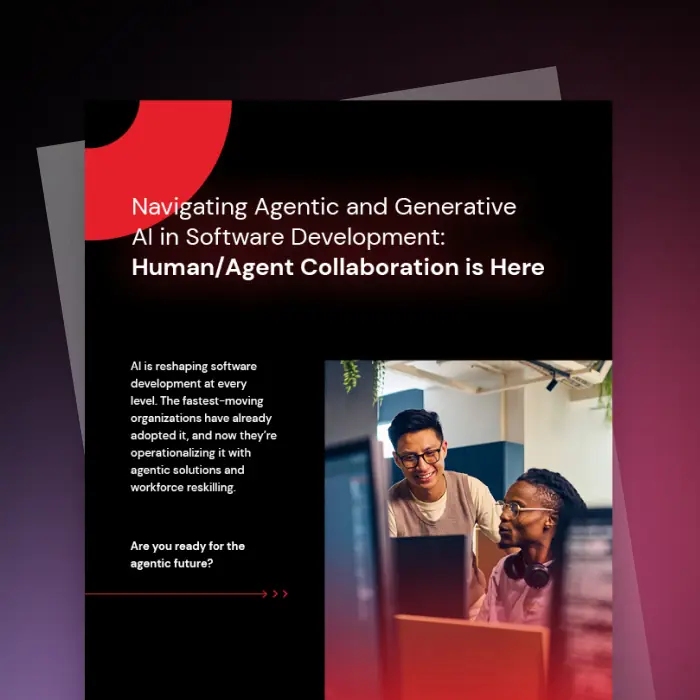
Table of contents:
- 1. If you could delegate any aspect of your software development lifecycle or business operations to an intelligent, autonomous system, what would it be?
- 2. What are your current limitations with off-the-shelf software or traditional development approaches in addressing your unique business needs?
- 3. How could the ability to build truly autonomous software agents that can learn, adapt, and execute tasks independently transform your business?
- 4. What new levels of agility and responsiveness could your organization achieve with AI agents proactively managing key processes?
- 5. Imagine AI agents that can not only build applications but also continuously monitor, optimize, and even anticipate future needs—what possibilities does this open up for your IT strategy?
- 6. How do you envision the collaboration between human teams and autonomous AI agents evolving within your workflows?
- The OutSystems take: The agentic AI future is bright
1. If you could delegate any aspect of your software development lifecycle or business operations to an intelligent, autonomous system, what would it be?
I would prioritize delegating:
- An initial pass of code reviews and refactoring suggestions
- Security, accessibility, and performance scans that extend beyond current static-analysis toolsets
- Automated regression, performance, and load testing integrated into CI/CD workflows
- Generation and ongoing maintenance of technical documentation
- Analysis of new requirements for gaps, implementation options, and cross-application impacts.
- Intelligent triage of stakeholder requests—capturing, prioritizing, and routing them based on capacity.
- Proactive user support that detects when a user is blocked and offers contextual guidance.
2. What are your current limitations with off-the-shelf software or traditional development approaches in addressing your unique business needs?
Key limitations include:
- Limited flexibility with commercial solutions that often require our processes to adapt to the tool, not vice versa
- Higher resource requirements for fully custom development, along with ongoing maintenance burdens
- Persistent data-quality and deduplication challenges that are not handled comprehensively “out of the box.
3. How could the ability to build truly autonomous software agents that can learn, adapt, and execute tasks independently transform your business?
Such agents could shorten development cycles, offload repetitive tasks, and allow staff to focus on high-value work. The result would likely be improved service reliability, reduced operating costs, and better alignment with evolving stakeholder needs.
4. What new levels of agility and responsiveness could your organization achieve with AI agents proactively managing key processes?
Potential benefits include:
- Faster identification and remediation of data issues
- Accelerated delivery of new features with improved quality
- Reduced downtime and fewer manual interventions, enhancing overall operational agility.
5. Imagine AI agents that can not only build applications but also continuously monitor, optimize, and even anticipate future needs—what possibilities does this open up for your IT strategy?
Agents with end-to-end capabilities could:
- Detect and address issues before they impact users.
- Identify usage patterns to inform user-experience improvements.
- Enforce complex business rules autonomously, reducing non-compliant data states and the remediation effort they require.
6. How do you envision the collaboration between human teams and autonomous AI agents evolving within your workflows?
I foresee a “trust-but-verify” model in which AI agents:
- Provide notifications, chat-based assistance, and in-context support.
- Handle routine tasks such as test execution, triage, and basic refactoring, with human review of natural-language rationales.
- Learn individual work styles over time, functioning as adaptive pair-programming partners.
- Continuously monitor application performance and user experience, alerting teams to anomalies and proposing resolutions.
Humans remain accountable for oversight, governance, and the strategic decisions that guide technology direction.
The OutSystems take: The agentic AI future is bright
Like the team at Yale, OutSystems sees a bright future for agentic AI in software development, with humans using their creativity to drive new ideas for apps and agentic AI handling the tedious and repetitive work and assisting with maintenance and change. To learn more about what human and AI collaboration can look like, read the latest OutSystems and KPMG report on agentic AI.